Lines in Composition: A Complete Guide
Horizontal, vertical, diagonal, curved and converging lines: what each does to the eye, where to find them and what settings to shoot them with.
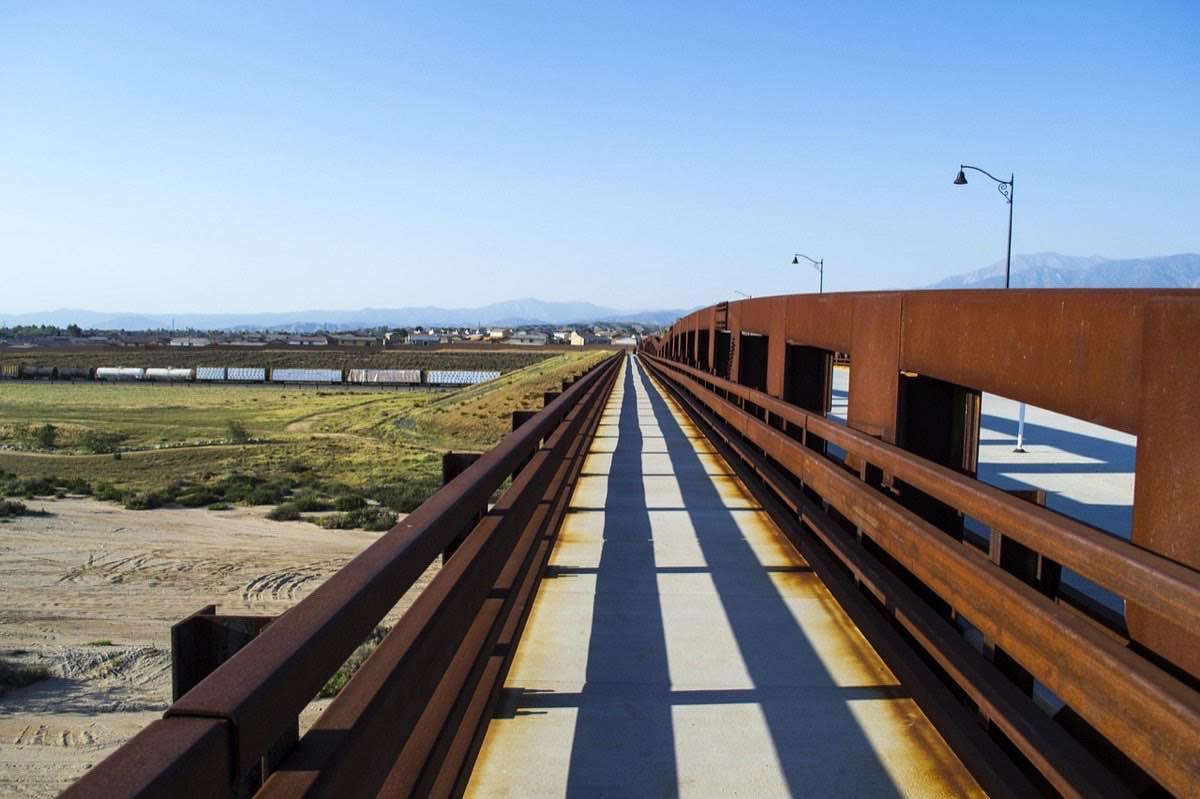
A diagonal crosses the entire frame; a horizontal stops against the edges. That difference decides how long someone keeps looking at your photo, and it is controlled by turning your body or changing format, not in editing. With the sun at 20° above the horizon, any object casts a shadow 2.7 times its height: there you have free diagonals during the first and last hour of light.
The six families below cover practically everything you will come across. The term leading lines sums up the definition; this is the usage table.
What does each type of line convey?
Type of line: Horizontal; Where it leads the eye: Side to side; stops at the edges; What it conveys: Calm, rest, scale; Where to find it: Sea horizon, fields, piers; How to shoot it: Landscape format, electronic level, f/11
Type of line: Vertical; Where it leads the eye: Bottom to top, in a single pass; What it conveys: Height, order, formality; Where to find it: Trees, columns, towers; How to shoot it: Vertical format, sensor plumb
Type of line: Diagonal; Where it leads the eye: Cuts through the frame in depth; What it conveys: Tension, movement, instability; Where to find it: Stairs, hillsides, long shadows; How to shoot it: Enter from a corner; sun below 20°
Type of line: Converging; Where it leads the eye: Straight to the vanishing point; What it conveys: Depth, attraction; Where to find it: Corridors, tracks, straight roads; How to shoot it: 16-24 mm, focus at the hyperfocal distance
Type of line: S-curve; Where it leads the eye: Meanders; holds longer; What it conveys: Slow journey, elegance; Where to find it: Rivers, paths, dunes, coastlines; How to shoot it: 35-50 mm from an elevated point
Type of line: Broken or zigzag; Where it leads the eye: Jumps from vertex to vertex; What it conveys: Unease, energy, rupture; Where to find it: Rocks, rooftops, cracks, lightning; How to shoot it: Side light to mark the edges
Focal lengths are for full frame. On APS-C, the 35-50 mm for curves becomes 23-33 mm.
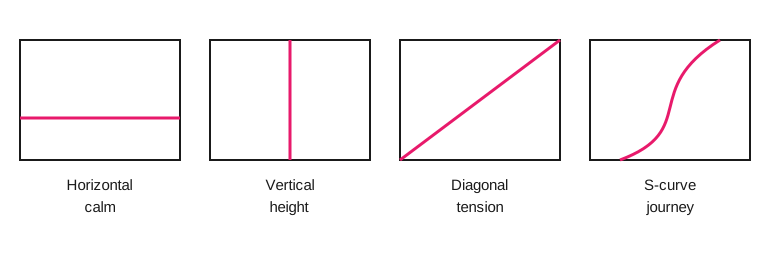
The same scene changes rhythm depending on which family of lines dominates the frame.
How do I get the horizon truly straight?
With the electronic level on, not by eye. One degree of tilt raises one end of the horizon by 105 pixels in a file 6000 px wide, and on a sea horizon that is visible from a meter away from the screen. In a scene with mountains nobody notices; at sea, everybody does.
Three rules that solve almost all horizontals:
Level on the waterline, not on the shore. The shore can really be tilted; the sea can't.
Decide where you put it before shooting. Centered splits the weight 50/50 and works with symmetrical reflections; at a third from the top or bottom, the dominant half decides the subject. The difference between placing the horizon at 33% or 38% is measured in the golden ratio in photography: it is 200 px in a file 4000 px tall.
At f/11 and 1/125 s with ISO 100 you have a well-exposed seascape with hazy sun (EV 14) and enough depth so that the shore and the horizon are sharp at the same time.
Straightening in editing always crops. One degree is corrected without drama; five degrees take a visible strip off each side and shift the framing you had composed.
Why do buildings lean in my photos?
Because you tilted the camera upward. It is pure geometry: as long as the sensor plane is vertical, the world's verticals come out parallel with any lens. As soon as you tilt it, they converge, and at 16 mm the effect is very pronounced.
What works, in order: level the camera and frame with extra ground to crop out afterward; find a viewpoint at mid-height of the building (a balcony, a bridge, a flight of steps); or correct in editing knowing it takes away part of the edges. If you are going to correct, frame wider than you think you need.
For verticals, vertical format is the way to go, and it isn't obvious: in landscape orientation, a 20 m column comes in cropped or tiny. Turning the camera takes a second and is usually the difference between the line running from edge to edge or stopping halfway.
When does a diagonal work and when does it just clutter?
It works when it enters from one corner of the frame and exits through another, or when it ends at the subject. It clutters when it starts and ends in the middle of a side, with no origin or destination: then it is a tilted object, not a compositional line.
The most reliable source of diagonals is the shadow. With the sun at 20° altitude, the shadow is 2.7 times the object's height; at 10°, 5.7 times. That turns a 4 m streetlamp into a 23 m diagonal lying across the asphalt, right at the hour when the light is also warm and from the side.
Settings for shadow diagonals at the last hour of light: f/8, 1/250 s, ISO 200 with low but direct sun, metering on the lit area and letting the shadow fall to black. If you expose for the shadow, you lose the pattern and you lose the line.
Curves, S-shapes and broken lines
The S-curve is the line that holds the eye longest because it forces a non-linear path. It needs two things: height and a medium focal length. From the ground, a winding river flattens and the S disappears; from 10 m of elevation with a 35-50 mm, it appears in full.
Broken lines (stepped cornices, cracks, rocky ridges) convey instability and work best with raking side light, which marks each edge with its own shadow. With frontal light they flatten out and the zigzag is lost.
When several lines converge toward the same point, you leave the territory of lines and enter that of perspective: that is covered separately in the vanishing point in photography.
Frequently asked questions
What do horizontal lines mean in a photograph?
They convey calm and stability because they echo the position of the body at rest and that of the natural horizon. A composition dominated by horizontals reads slowly and without tension, which makes it ideal for seascapes, fields and low architecture, and a poor choice when you want a feeling of movement.
Why do diagonals give more dynamism?
Because they don't coincide with any of the four edges of the frame, so the eye finds nowhere to stop and travels across the picture from corner to corner. That longer path is what is perceived as movement; a vertical or a horizontal ends at a parallel edge and brakes.
How many lines should a photo have?
One that dominates and, at most, two secondary ones that support it. With three or more families competing, the eye is divided and none directs anything; the remedy is usually to step back, change height or tighten the frame until only one is left.
Are lines useful in portraiture or only in landscape and architecture?
They are useful in portraiture as a frame and as an arrow: a railing, a corridor or the edge of a wall pointing at the subject reinforces the framing without the person losing prominence. Stop down to f/5.6 or more so the line remains recognizable; at f/1.8 it dissolves and stops directing anything.
What to look for in the first thirty seconds
Before raising the camera, locate the longest line in the scene and decide whether you are going to use it or avoid it. Then see whether it enters from a corner; if not, move until it does. And check which format it fits in whole: many weak frames are horizontals shot vertically and vice versa. The rest of the compositional repertoire that relies on these lines is in the dynamic visual composition guide.
The 44 Enfogram cards come with the composition resources and the settings for each scene printed, to consult with the tripod set up and the sun going down.