Poses for Men's Photos
Eighteen poses for male portraits with jaw angle, camera height and full-frame settings for outdoors, studio and street.
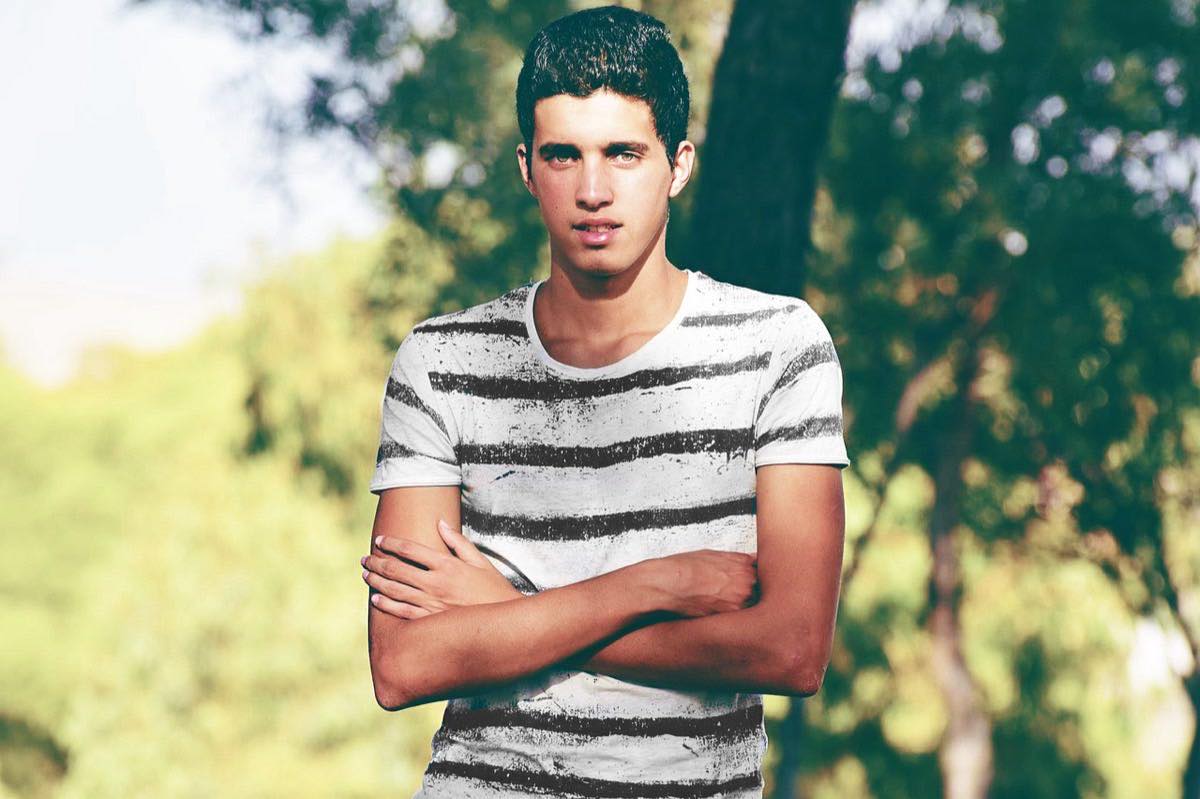
Camera at chest height, chin forward 3 cm, broad shoulders toward the lens and weight on the back leg. That combination defines the jawline and gives presence without the posture looking rehearsed. On full frame in open shade, 85 mm at f/4 and 1/250 s with ISO 100 gives you about 14 cm of sharpness at 2.1 m: the face fits and the forward shoulder fits.
Male portraiture reverses two decisions of female portraiture. The camera goes down instead of up, and the shoulders open instead of narrowing. The rest (hands, gaze, light) is the same craft.
What changes when posing a man?
Four things, and all are decided before the first shot.
Camera height drops to the chest or sternum. From above you lose the jaw and gain forehead; from below, the chin line is cut out against the background.
The shoulders open toward the lens, between 0° and 30°, not the 45° of the classic portrait. A man turned 45° looks narrow, and narrow tends to read as insecure.
The chin goes forward, never up. Pushing it forward tightens the skin under the jaw; lifting it shows the nostrils.
A resting expression is valid. A closed mouth and a steady gaze work in male portraiture without the photo looking angry. There's no need to force a smile.
The base starting posture (weight, feet and turn) is the same as in 30 poses for photographs; what changes here is the height of the lens and the width of the shoulders.
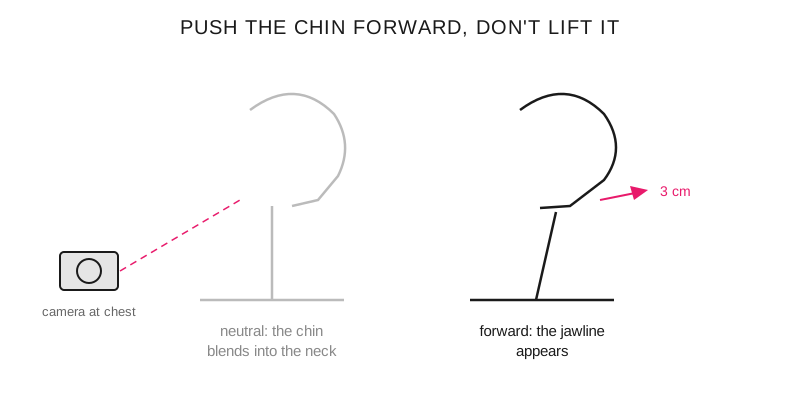
The chin moves forward along the horizontal. If it also rises, the photo goes from steady to arrogant.
The 18 poses, by context
#: 1; Pose: Standing, hands in pockets, thumbs out; Context: Urban outdoors; What it fixes: Arms with nowhere to go
#: 2; Pose: One thumb in the belt loop; Context: Outdoors, full body; What it fixes: Elbow stuck to the torso
#: 3; Pose: Arms crossed at chest height; Context: Corporate portrait; What it fixes: Torso without volume
#: 4; Pose: Hand adjusting the shirt cuff; Context: Suit; What it fixes: Stiff hands
#: 5; Pose: Open hand on the lapel; Context: Suit or coat; What it fixes: Flat front-on photo
#: 6; Pose: Shoulder against the wall, feet crossed; Context: Alley, doorway; What it fixes: Symmetrical posture
#: 7; Pose: Elbow on a ledge, body at 20°; Context: Bar, counter; What it fixes: Lack of anchoring
#: 8; Pose: Walking toward the camera, coat open; Context: Street; What it fixes: Static photo
#: 9; Pose: Sitting on the edge, elbows on knees; Context: Studio, step; What it fixes: Slumped back
#: 10; Pose: Sitting with ankle over knee; Context: Armchair, interview; What it fixes: Legs together and flat
#: 11; Pose: Crouching, forearms on knees; Context: Outdoors, ground; What it fixes: Repeated standing framing
#: 12; Pose: Hand behind the neck, elbow out; Context: Half-length portrait; What it fixes: Silhouette without height
#: 13; Pose: Profile with gaze forward; Context: Character portrait; What it fixes: Asymmetrical face
#: 14; Pose: Three-quarter with forward shoulder; Context: Base portrait; What it fixes: Long or narrow neck
#: 15; Pose: Holding a tool of the trade in the hands; Context: Work portrait; What it fixes: Empty hands, photo without a story
#: 16; Pose: Leaning on the hood or railing, weight forward; Context: Outdoors; What it fixes: Torso leaning back
#: 17; Pose: Back to camera, head turn; Context: Series closer; What it fixes: Repetitive gallery
#: 18; Pose: Laughing after a prompted laugh; Context: Any; What it fixes: Passport-photo smile
Poses 1 to 8 are standing, 9 to 11 seated or low, 12 to 14 bust-length and 15 to 18 are full scenes for when ideas have run out. With those eighteen and three gaze variants for each you have material for a one-hour session.
How do I get a defined jawline without retouching?
With three physical levers, in this order of effect.
Distance. At 35 mm from 1 m the nose grows and the chin recedes; at 85 mm from 2.1 m the face flattens just enough and the jaw gets drawn. If you can only change one thing, step back and lengthen the focal length.
Height. Camera at chest, lens barely tilted upward. Every 10 cm you raise the camera takes a bit of line away from the chin.
Light. A high and slightly lateral source (45° up, 45° to the side) creates the shadow under the cheekbone and under the jaw that separates the face from the neck. A large frontal light does the opposite: it fills that shadow and erases the jaw. The simplest window setup to achieve it is in window-light portrait.
And an honest limitation: if the neck and chin form an open angle, no pose turns it into a closed angle. Pushing the chin forward improves the line; it doesn't invent it.
What settings do I use for male portraits?
Numbers for full frame, fixed ISO so you can check exposure against the scene.
Scene: Hard midday sun, strong shadow; Focal length: 85 mm; Aperture: f/4; Shutter speed: 1/2000 s; ISO: 100; What it costs: Deep eye shadows if you don't fill
Scene: Open shade; Focal length: 85 mm; Aperture: f/4; Shutter speed: 1/250 s; ISO: 100; What it costs: Soft modeling, little character
Scene: Heavy overcast; Focal length: 85 mm; Aperture: f/2.8; Shutter speed: 1/250 s; ISO: 100; What it costs: Flat light; look for a dark background
Scene: Indoors next to a window; Focal length: 50 mm; Aperture: f/2; Shutter speed: 1/125 s; ISO: 400; What it costs: 6 cm of sharpness: one movement and it fails
Scene: Lit street at night; Focal length: 35 mm; Aperture: f/1.8; Shutter speed: 1/160 s; ISO: 1600; What it costs: Visible noise in shadows and mixed color temperatures
Scene: Full body, three-quarter-length shot; Focal length: 50 mm; Aperture: f/5.6; Shutter speed: 1/250 s; ISO: 400; What it costs: The background reads: choose it beforehand
Hard sun is not an enemy in male portraiture: strong shadow defines, and many of the best photos of men are made at midday with the subject facing 45° from the sun. What you need to control is the eye shadow, and for that a white reflector at chest height at 1.5 m is enough.
Before going below f/2.8 in a half-length portrait, calculate how much sharpness you have left in the depth of field calculator. At 85 mm and f/1.4 at 1.5 m you're under 3 cm: if he breathes backward, you lose the eye.
The mistake with hands and arms
Men's arms usually hang at rest, and hanging they stick to the torso and flatten against the shirt. Separate the elbow a couple of centimeters from the side and the sleeve recovers its shape.
A closed fist looks tense. Relaxed hand, fingers slightly curved.
A single thumb inside the pocket is cleaner than the whole hand.
Sleeve rolled up below the elbow, not above: a high roll cuts the arm at its widest point.
Watch and rings toward the side facing the camera only if they're part of the portrait; if not, turn them out of sight.
In corporate portraiture there is a fifth: crossed arms work at chest height and fail at navel height, where the gesture reads as defensive and also widens the waist.
Frequently asked questions
At what height do I put the camera to photograph a man?
At chest or sternum height, with the lens tilted slightly upward. From eye level the jaw shortens and from above it is lost entirely; dropping to the chest the chin line is cut out against the background and the figure gains apparent height.
Which lens is best for male portraits?
On full frame, 85 mm for bust and half-length and 50 mm for full body in tight spaces. What matters is not the focal length but the distance it imposes: closer than 1.5 m to the subject, any lens widens the nose and sinks the chin.
How do I pose a man who feels ridiculous in front of the camera?
Give him a physical task instead of a pose: walking toward you, adjusting his sleeve, leaning on a wall or looking out the window and turning his head when you say so. The discomfort comes from not knowing what to do with the body, and a concrete action eliminates it in under a minute.
Can the same poses be used for suit portraits and casual portraits?
Yes, changing how open the body is. With a suit it is wise to keep the shoulders more closed and the back straight because the garment already provides structure; with casual clothing you can open the torso, shift the weight and break the line without the image losing formality.
What to bring written down to the session
Three numbers and a list: camera at chest, 85 mm at 2.1 m, f/4 as the default aperture outdoors. And the four rescue poses (hands in pockets, elbow resting, sitting with elbows on knees and back to camera with a turn) that cover standing, leaning, seated and from behind.
The context of light, lens and direction that supports all of this is developed in the contemporary portrait photography guide.
The 44 cards from Enfogram come with camera height, shoulder angle and settings by scene printed on them, to consult with the subject in front of you instead of improvising.