Waterfall Photography: The Exact Shutter Speed for Each Effect
How to photograph waterfalls: exact shutter speeds to freeze, texture or silk the water, with full settings and recommended filters.
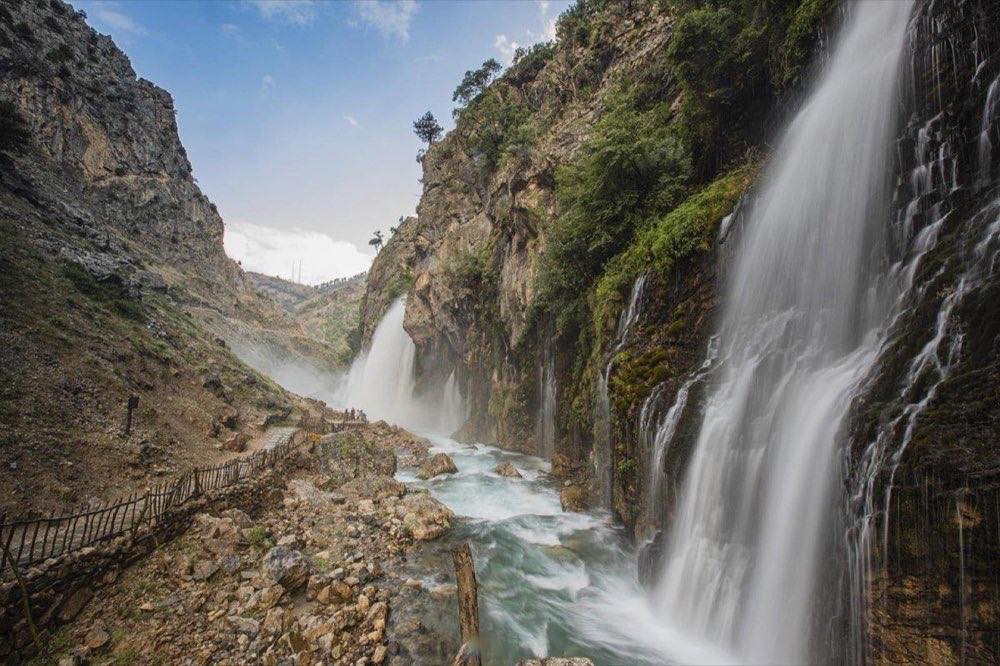
Water is the only element in a landscape that you can "draw" with shutter speed. When photographing waterfalls, the same scene can become a frozen explosion of droplets, a textured curtain or an ethereal white silk, just by changing the exposure time. There is no single correct speed: there is a speed for every intention.
Most tutorials stop at "use a long exposure." But the difference between 1/4 of a second and 2 seconds is enormous in the result, and it also depends on the flow, the height of the drop and how far away you are.
What shutter speed should I use for each effect?
Frozen water (1/500 s to 1/2000 s). Every drop hangs suspended in the air. It works on violent, high-volume waterfalls, where the chaos of droplets has graphic power. Typical setting: 1/1000 s, f/4, ISO 400–800 depending on the light. It is the least-used effect and therefore the most surprising.
Flowing texture (1/8 s to 1/2 s). The middle ground: the water shows movement but keeps its streaks and inner detail. It is the most natural effect and the favorite for waterfalls with medium flow. Typical setting: 1/4 s, f/11, ISO 100.
Full silk (1 s to 8 s). The water turns into a white, uniform, ethereal surface. Ideal for thin, elegant falls or for a minimalist look. More than 8 seconds rarely adds anything on the waterfall itself (the water is already completely smooth), although it does lengthen the trails in the pool.
Field rule: the faster the water falls and the closer you are, the shorter the exposure can be for the same effect. A 30-meter drop seen up close turns to silk at 1/2 s; a distant thread of water may need 4 seconds.
How do I reach that speed in full sun?
The challenge is not choosing the speed, it is reaching it. At midday, with ISO 100 and f/11, the meter will give you around 1/250 s: far too fast for any motion effect. Your tools, in order:
Lowest ISO: drop to ISO 100 (or ISO 50 if your camera offers it as an extended setting).
Stop down the aperture: f/11 is the reasonable limit; f/16 starts to cost sharpness through diffraction.
Polarizer: it takes away about 2 stops and, as a bonus, removes glare from wet rocks. On waterfalls it is almost mandatory.
ND filter: the one that does the heavy lifting. An ND8 (3 stops) turns 1/250 s into 1/30 s; an ND64 (6 stops) takes it to 1/4 s; an ND1000 (10 stops) to 4 seconds.
Converting filter stops into seconds in your head is error-prone; you can calculate the exact shutter speed with your ND filter before shooting and get it right on the first try. And if you want to understand in depth how shutter speed draws motion, the shutter speed guide covers everything from panning to night exposure.
Settings table by effect and light condition
Desired effect: Frozen drops; Speed: 1/1000 s; Shade/forest light: f/2.8, ISO 1600; Full sun: f/5.6, ISO 100
Desired effect: Subtle movement; Speed: 1/15 s; Shade/forest light: f/11, ISO 100; Full sun: f/11, ISO 100 + CPL + ND4
Desired effect: Flowing texture; Speed: 1/4 s; Shade/forest light: f/11, ISO 100 + CPL; Full sun: f/11, ISO 100 + ND64
Desired effect: Classic silk; Speed: 1 s; Shade/forest light: f/11, ISO 100 + ND16; Full sun: f/11, ISO 100 + ND64 + CPL
Desired effect: Silk + smooth pool; Speed: 4 s; Shade/forest light: f/11, ISO 100 + ND64; Full sun: f/11, ISO 100 + ND1000
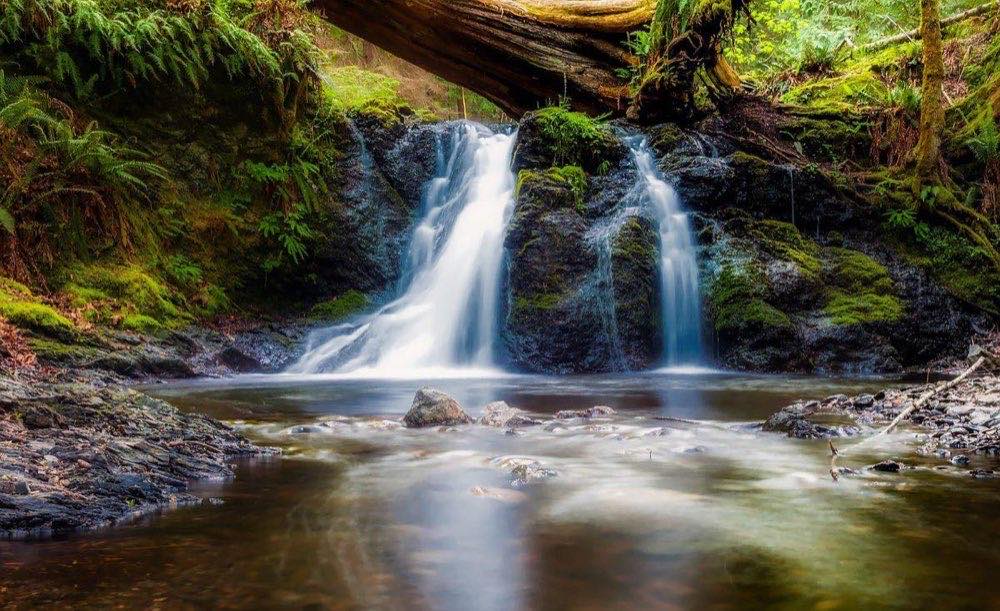
Starting values: adjust by ±1 stop depending on the flow and check the histogram after the first shot.
Field technique: tripod, shutter release and protection
A stable tripod, not a tall one. The best waterfall compositions are usually low, close to the water. Plant the legs firmly between the rocks and hang your backpack from the center hook if it is windy.
Fire without touching the camera. Use the 2-second timer or a remote release. On a DSLR, turn on mirror lock-up; on a mirrorless, use the electronic first-curtain shutter.
Protect your gear from spray. Waterfalls spit out a constant mist that settles on the filter. Carry two or three dry microfiber cloths, compose with the lens cap on and clean the glass right before each shot. A ten-second exposure with a single drop on the filter is a lost photo.
Watch the highlights. White water is the first thing to blow out. Expose to keep detail in the foam: apply -0.3 to -0.7 EV and check that the histogram does not touch the right edge. The rest of the scene can be recovered in editing.
Double exposures for the surroundings. If at 4 seconds the nearby leaves come out blurred by the wind, take a second shot at 1/60 s with a higher ISO and blend them in editing: silky water and sharp foliage.
What if the waterfall is not the subject?
A centered, complete waterfall is usually the most boring photo of the place. Alternatives that work:
The stream as a line: go downstream and use the channel as a leading line toward the fall.
Details with a telephoto lens: at 70–200 mm, isolate one section of the fall against dark rock; the contrast of silk against black is very graphic.
Vertical format: most waterfalls are taller than they are wide; a vertical frame gives them their natural proportion.
A scale element: a human figure in colored clothing turns an anonymous waterfall into a story (and reveals its real size).
These framing decisions rest on the same principles as controlling dynamic range in complex landscapes and shutter speed as an expressive tool.
Frequently asked questions
What shutter speed should I use if I don't have ND filters?
Shoot during the shaded hours (sunrise, sunset or waterfalls inside a forest), use ISO 100 and f/16: in those conditions you will reach 1/4 s to 1 s without filters. A polarizer, if you have one, adds almost 2 stops.
Why does my silky water come out blown out and without detail?
Overexposure: blown-out foam loses texture and becomes a flat blotch. Apply -0.7 EV, turn on the highlight warning and recover the shadows later in RAW.
Can I photograph waterfalls without a tripod?
Up to 1/8 s with modern stabilization and good technique, yes. For exposures of 1 second or longer, no stabilizer will save you: rest the camera on a rock with the strap as a cushion if you don't have a tripod.
What is the best time of year to photograph waterfalls?
After the spring rains or during the thaw, when the flow is generous. With low flow, get closer and work on details; with excessive flow, the water loses its shape and everything turns to foam.
What goes in your backpack
Shutter speed is your brush: 1/1000 s freezes the fury, 1/4 s draws the streaks and 2 seconds paint silk. Decide the effect first, calculate the exposure afterward and use filters to reach it at any hour.
Keep the polarizer on, the ND in your pocket and two dry cloths: with that and this table, no waterfall will resist you. At Enfogram you will find the 44 photography cards with the exact settings for every situation: print them, carry them with you and shoot with confidence.