Skip to content
← All guides

Shutter Speeds

Shutter speed controls light and motion: there is no universal correct speed, it depends on your artistic intent.

Shutter Speeds

Shutter speed controls two crucial aspects: the amount of light that reaches the sensor and how motion is recorded. Motion can be frozen, suggested or exaggerated with creative pans. There is no universal "correct" speed (it depends on your artistic intent).
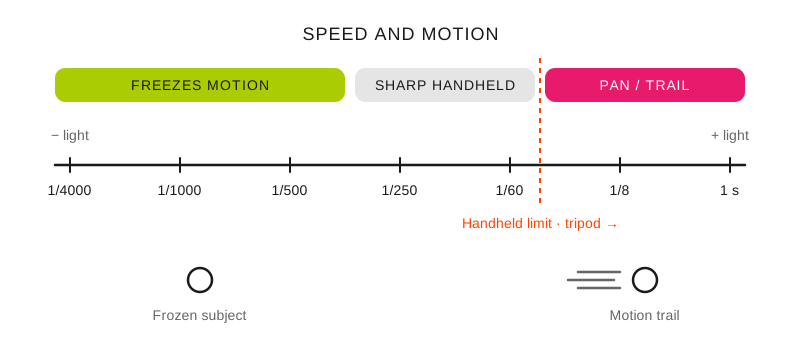
Shutter speed scale from 1/4000 to 1 second: fast speeds freeze motion, medium ones allow handheld shooting and slow ones create pans and blur that require a tripod

From 1/4000 s to 1 s: fast speeds freeze motion and slow ones draw it as a trail (with a tripod).

Shutter speed for sharp images

  • 1/1000 – 1/4000: objects moving at high speed, to freeze the image.

  • 1/60 – 1/250: static objects or ones with slight movement.

  • 1/30 – 10”*: captures motion with pans.

Situation

  • 1/4000: extraordinarily fast objects.

  • 1/1000: very fast motion, car racing and some sports.

  • 1/500: people running and other objects.

  • 1/60 – 1/250: people moving at normal speed, children.

  • 1/60: people posing and other objects.

Long exposure / creative effects

  • 1/30 – 1/2 s*: panning on moving objects: waterfalls, rivers, car lights.

  • 2”*: prolonged exposure: fireworks, lightning during a storm.

  • 5”–10”*: long exposure: light painting, stars, milky effect on moving water.

*Using a tripod is recommended for long exposure times.

  • Blog
    Manual Mode vs Aperture Priority: Which Should You Use?

    Manual mode or aperture priority: when each makes sense, with real scenarios, concrete settings and the myth of manual as the pro's mode, debunked.

  • Glossary
    Color temperature (Kelvin)

    Color temperature describes whether a light source leans orange or blue, measured in Kelvin (K). Low values are warm light and high values are cool light.

  • Guide
    Exposure in Complex Landscapes

    Landscapes pose the biggest dynamic range challenge: your sensor can't capture everything you see, so you must decide which tones to preserve.

  • Blog
    Shutter Speed: Exposure and Motion

    Shutter speed: which value freezes or blurs each kind of movement, with a table by scenario and the most common mistakes.

  • Glossary
    Shooting modes (P, A, S, M)

    The shooting modes on the dial split control of the exposure between you and the camera: program, aperture priority, shutter priority and manual.

  • Guide
    Exposure Compensation: How and When to Use It

    Exposure compensation lets you make a photo come out lighter or darker than the reading your camera calculates automatically.