Autofocus Systems
Modern autofocus systems offer multiple zones, predictive tracking and subject detection: choose the right mode for each situation.
Current systems offer multiple zones, predictive tracking and subject detection. The key is selecting the right mode for each situation and understanding their differences. Even manual focus is an option when technology can't interpret your creative intention.
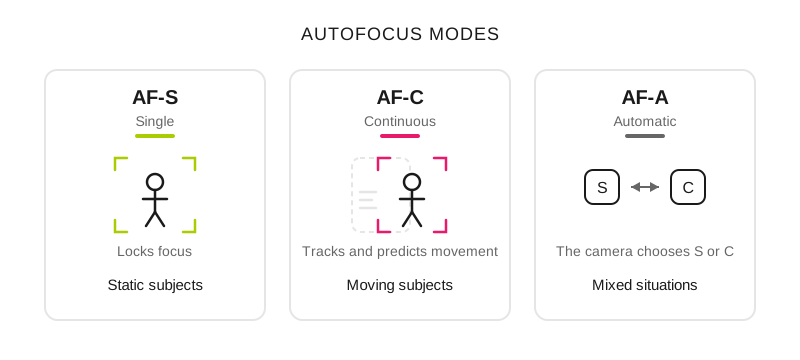
AF-S locks focus for static subjects, AF-C tracks it on moving ones and AF-A leaves the decision to the camera.
AF-A — Automatic autofocus
When you select AF-A, you're giving the camera control over whether to select AF-S or AF-C. This selection works best when you have a camera with many focus points (50 or more).
AF-S — Single-servo autofocus
In this mode, when the shutter button is pressed halfway, focus locks. Use it when photographing stationary subjects or when you indicate exactly where the focus will be placed (for example, the subject's eyes).
AF-C — Continuous-servo autofocus
When the shutter button is pressed halfway, the camera focuses continuously and then activates "predictive focus tracking". This lets the camera follow the subject's movement and predict where the subject will be when the shutter opens. Use it when photographing fast-moving subjects.
When to avoid it
If the camera can't read the subject automatically, it may focus on the wrong area. In these cases it's best to use manual focus.
Low contrast.
When the landscape is dominated by geometric patterns.
Subjects behind bars, fences, etc.
Lots of fine detail.
The background is larger than the subject.
Practical application
AF-S + single point: static portraits, precise compositions.
AF-C + dynamic zone: sports, children in motion.
AF-A + face detection: family events, social photography.
Manual focus: macro, astrophotography, low-contrast situations.
What setup do I use in each scene?
Portraits: AF-S, single point, focus on the nearest eye.
Sports: AF-C, wide zone, tracking activated.
Landscapes: AF-S or manual, focus on the zone of maximum sharpness.
Low light: AF-S with AF assist light.
Common mistakes
Using continuous AF for static subjects (less precise).
Relying only on the center focus point.
Not verifying focus in critical situations.
Decoupling focus from the shutter button without understanding its advantages.
Pro tips
Decouple focus from the shutter button and assign focus to a rear button for more control.
At events, alternate between AF-S for posed photos and AF-C for spontaneous moments.
For macro, use manual focus + magnification in live view.