Depth of Field in Practice
Depth of field directs the viewer's attention and creates visual hierarchy: your most powerful storytelling tool.

With an 85 mm at f/1.8 and the subject at 1.5 m you have 3.2 cm of sharp zone: both eyes fit only if the face is straight on. Stop down to f/2.8 and you go to 4.9 cm. The figures in this guide assume a full frame sensor and a circle of confusion of 0.030 mm; with another format the distances change, not the logic.
Depth of field (DOF) is your most powerful storytelling tool. It not only determines what is in focus, it directs the viewer's attention and creates visual hierarchy. DOF depends on three factors you control: aperture (the most important), the distance between the camera and the subject and the focal length. Understanding these relationships turns blur into a decision and not an accident.
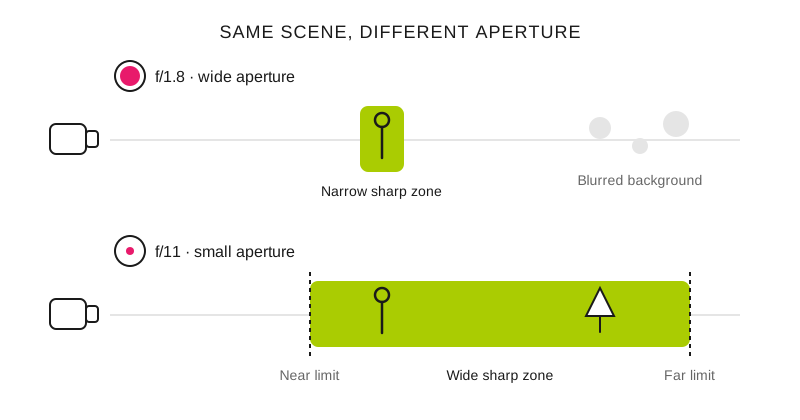
At the same distance from the subject, opening the aperture (f/1.8) narrows the sharp zone and closing it (f/11) widens it.
How does aperture change depth of field?
Scale of f/1.4, f/2, f/2.8, f/4, f/5.6, f/8, f/11 to f/22:
The larger the aperture, the shallower the depth of field.
The smaller the aperture, the greater the depth of field.
Each step of the scale multiplies or divides the sharp zone by roughly 1.4, and the price is exactly one stop of light that has to be paid back with shutter speed or ISO. The depth of field calculator gives the exact number for your combination of format, focal length, aperture and distance.
Focal length
On full frame and APS-C:
Telephoto: above 50 mm (full frame) / above 30–35 mm (APS-C).
Normal: 50 mm / 30–35 mm.
Wide angle: below 50 mm / below 30–35 mm.
Effect on DOF:
Longer focal length (more millimeters): reduced DOF, more blur.
Shorter focal length (fewer millimeters): wide DOF, more sharp area/less blur.
To convert a focal length from one format to another without doing the math by hand there is the crop factor converter.
How much does the distance to the subject matter?
Subject closer to the camera: reduced DOF / more blur.
Subject farther from the camera: wide DOF / sharper background.
Subject farther from the background: background out of focus.
Subject close to the background: background in focus or slightly blurred.
The last two lines are the ones most people ignore: the subject-to-background distance doesn't change your sharp zone by a single millimeter, but it decides how much bokeh you see behind. It is the free lever, and it is operated with your feet.
What aperture do I use in each scene?
Close-up portrait: f/1.8, approximately 1.5 m from the subject, and 5 m or more between subject and background.
Group portrait: f/5.6, distance 3 m or more, everyone in the same plane of focus.
Dramatic landscape: f/11, focus at 1/3 of the scene, foreground at 2 m.
Creative macro: f/11 – f/22 to maximize depth of field.
With the numbers in front of you, measured on full frame:
Scene: Close-up portrait; Focal length: 85 mm; Aperture: f/1.8; Focus distance: 1.5 m; Sharp zone: 3.2 cm
Scene: Loose single portrait; Focal length: 85 mm; Aperture: f/2.8; Focus distance: 1.5 m; Sharp zone: 4.9 cm
Scene: Couple, two faces; Focal length: 85 mm; Aperture: f/4; Focus distance: 3 m; Sharp zone: 29 cm
Scene: Small group in a line; Focal length: 50 mm; Aperture: f/5.6; Focus distance: 3 m; Sharp zone: 1.24 m
Scene: Landscape with foreground; Focal length: 24 mm; Aperture: f/11; Focus distance: 1.77 m (hyperfocal); Sharp zone: 0.88 m → ∞
Scene: Life-size macro; Focal length: 100 mm; Aperture: f/11; Focus distance: 1:1 ratio; Sharp zone: 1.3 mm
Read the last row twice. At life size and f/11 you have a little over a millimeter: a bee's eye fits, the eye and the antenna don't.
Suggested setups
Single portrait: f/1.4–f/2.8 with 85 mm or 135 mm.
Couples: f/2.8–f/4 to include both faces.
Small groups: f/5.6–f/8, arrange in a line parallel to the sensor.
Landscapes: f/8–f/11 (the sweet spot of most lenses).
Common mistakes
Always using f/1.4 for "more bokeh" without considering the subject.
Not checking that the eyes are in the critical plane of focus.
Forgetting that DOF is shallower at short distances.
Confusing motion blur with depth of field.
The fourth is solved by looking at the background: if the background is sharp and the subject isn't, it is motion, not depth of field, and it is corrected with shutter speed.
Professional tips
Golden rule: in portraits always focus on the eye closest to the camera.
To maximize bokeh: use the widest aperture possible + the longest focal length + move closer to the subject.
In groups use f/5.6 as a starting point and adjust according to the spatial arrangement.
Frequently asked questions
How much depth of field do I have at f/1.8?
On its own, the aperture doesn't answer: you need the focal length and the distance. On full frame, an 85 mm at f/1.8 focusing at 1.5 m leaves 3.2 cm of sharp zone, while a 50 mm at f/1.8 at the same distance leaves about 9.4 cm because the shorter focal length widens the zone. At a distance of one meter those 3.2 cm drop to a little over a centimeter.
Does depth of field change between full frame and APS-C?
Yes. With the same framing and the same f-number, an APS-C sensor gives slightly more than one extra stop of depth of field, because to frame the same you use a shorter focal length or stand farther back. Put the other way around: to match the blur of a full frame at f/2.8 on APS-C you would have to shoot near f/1.8.
Where do I focus in a landscape to get everything sharp?
At the hyperfocal distance, not at infinity. With a 24 mm at f/11 on full frame the hyperfocal falls at 1.77 m: focusing there gives you acceptable sharpness from 0.88 m to infinity, which more than covers a foreground at 2 m. The hyperfocal calculator returns that number for your format, focal length and aperture.
Why does almost everything come out blurred in macro even if I stop down?
Because at a 1:1 reproduction ratio depth of field collapses: at f/11 about 1.3 mm remain, and stopping down to f/22 barely doubles it while diffraction starts eating the sharpness you gained. The way out is focus stacking: several shots shifting the focus plane and merging them afterward.
What blurs the background more, opening the aperture or moving the subject away from the background?
Moving the subject away, almost always. Going from f/2.8 to f/1.8 gains a little over a stop of blur and costs you about a third of your focus margin; moving the subject from 1 m to 5 m from the background multiplies the background blur without touching the aperture or risking an eye falling out of the sharp plane.
The three numbers you decide before shooting
Focal length, aperture and distance to the subject: the three together give a figure in centimeters, and that figure has to be greater than how much your subject moves between when you focus and when you shoot. If it is smaller, stop down one stop or step back half a meter. For landscapes, change the question to the hyperfocal distance and focus there.
The 44 Enfogram cards come with this depth of field table printed (focal length, aperture, distance and sharp centimeters) to consult with the subject already in place.