Developing a Personal Style and Portfolio
Your photographic style is your visual signature: not a preset, but technical, compositional and emotional choices that repeat across your work.
A portfolio stays at 15–25 printed images, and on the web it loses strength past 20. Everything you add above that figure lowers the average, because a client will judge you by your worst photo. Style is what makes those 20 read as a single voice and not as twenty separate jobs.
Your photographic style is your visual signature, the consistent way you see and interpret the world. It is not a preset or filter, but a combination of technical, compositional and emotional choices that repeat across your work. Style development is evolutionary: it emerges naturally when you master technique and can focus all your attention on personal expression.
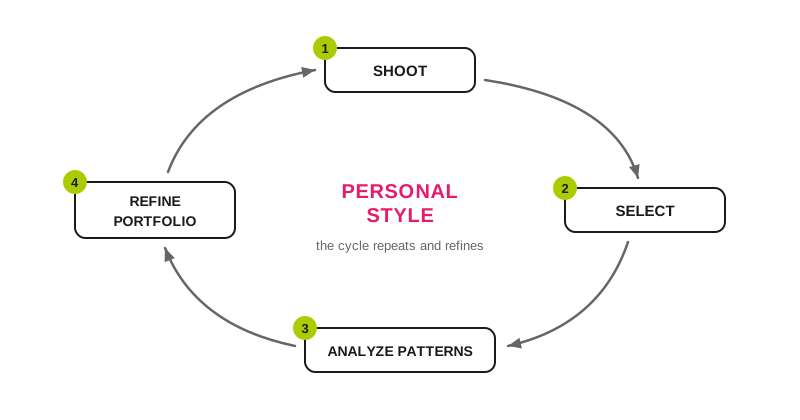
Style isn't chosen: it emerges from repeating the cycle of shooting, selecting, analyzing and refining.
Why do style and portfolio go together?
It's time to move from showing photos to telling who you are as a photographer. Photographic style and portfolio coherence are two inseparable pillars for attracting clients. Showing technique isn't enough: you must convey a voice of your own that speaks clearly and sets your work apart in a competitive market.
A well-selected portfolio demonstrates professionalism, order and vision. It tells the client "this is what I do, and I do it with identity." That coherence not only inspires trust, it also filters and attracts the clients who value your aesthetic proposal. The term photography portfolio covers what is expected to be found inside and in what order.
How do I find my style?
Personal analysis: review 100 of your best photos, identify recurring patterns.
Controlled experimentation: choose one element (color, light, composition) and explore it deeply.
Conscious influences: study photographers you admire, identify what specifically attracts you.
Editorial coherence: all the photos in the portfolio must "speak the same language."
Personal analysis is the one that gives measurable results and that almost nobody does: put 100 of your photos in a grid and count how many share the same time of day, the same distance to the subject, the same palette and the same kind of light. What repeats without you having decided it is already your style. The annual selection method is in your best photos of the year: how to choose them.
How many photos does a portfolio have?
Physical portfolio: 15–25 images maximum, superior print quality.
Digital portfolio: intuitive navigation, fast loading, design that adapts automatically to different media.
Social media: coherent content, consistent frequency, seeking loyalty.
Presentation: each image must contribute something unique to the whole.
Each medium calls for a different number and a different review rhythm:
Medium: Printed portfolio; How many images: 15–25; What it demonstrates: Print quality and controlled sequence; How often it is reviewed: 6 months
Medium: Own website; How many images: 20, split into 2 or 3 series; What it demonstrates: That you know how to edit and not just shoot; How often it is reviewed: 6 months
Medium: Social media; How many images: The first 9 visible in the grid; What it demonstrates: Coherence at first glance; How often it is reviewed: Continuous
Medium: Proposal to a client; How many images: 10–12, only from the genre they are hiring you for; What it demonstrates: That you've already solved their kind of job before; How often it is reviewed: Per project
The printed portfolio row carries a technical decision: what size you print at and how many megapixels you have. The print size calculator tells you how far your file goes before the lack of resolution shows.
Common mistakes
Imitating popular styles without developing a voice of your own.
A portfolio that is too varied with no clear common thread.
Including mediocre work to "fill" numbers.
Not updating the portfolio as your style evolves.
Professional tips
Portfolio rule: better 10 exceptional photos than 50 good ones.
Seek feedback from respected colleagues, not just likes on social media.
Review and update your portfolio every 6 months, remove work that no longer represents you.
Frequently asked questions
How many photos should a portfolio have?
Between 15 and 25 in a printed portfolio, and around 20 on the web split into two or three series. The reason is arithmetic: the client averages what they see, so adding a merely correct photo to a set of excellent photos lowers the average. The developed argument, with the criteria for cutting, is in a portfolio that sells: 20 photos, not 200.
Can I mix weddings, product and landscape in the same portfolio?
On the same page, no. A wedding client who sees product photos among yours concludes that weddings are a side job. Separate by series with their own entry and their own order, and show only the series that interests whoever writes to you.
How often do I update the portfolio?
Every six months, and always removing something. If in a review you can't remove a single image, it's a sign you aren't shooting new work better than the previous work, and that is a practice problem and not a selection problem.
How do I know if I already have a style?
When someone can identify a photo of yours without seeing your name. The practical test is the review of 100 images: if when grouping them three or four clear constants appear (a time of day, a type of framing, a palette, a distance to the subject), you have a style even if you still can't describe it in words.
Does a preset give me a style?
No. A preset matches the color of a set of photos, which is the most superficial layer and the easiest to copy. Style is formed before shooting: what you get close to, what light you work with, what you leave out of the frame and what moment you choose. How that turns into reputation and clients is in the personal brand development and networking guide.
The exercise that makes your style visible
Choose 100 of your photos, export them at low resolution, look at them together in a grid and keep the 20 you could sign. Then write in one line what they share. That line is your style statement, and the portfolio arranges itself once you have it written.
The 44 cards from Enfogram come with the portfolio selection and editing criteria printed on them, to review on the table while you choose.