Photography Business and Marketing
Turning passion into a sustainable business takes strategic pricing, effective marketing, exceptional service and responsible finances.

Your minimum rate comes from a division: (annual operating costs + the salary you want) ÷ billable days per year. If you work 100 days a year and need to cover 12,000 in expenses and take home 24,000, your day cannot drop below 360. Everything else (niche, portfolio, marketing) serves to fill those 100 days, not to justify charging less.
Turning photography into a sustainable business calls for skills that are not in the camera: pricing, marketing, customer service and financial management. Differentiation in a saturated market comes from combining your own style, a defined niche and a client experience that is remembered.
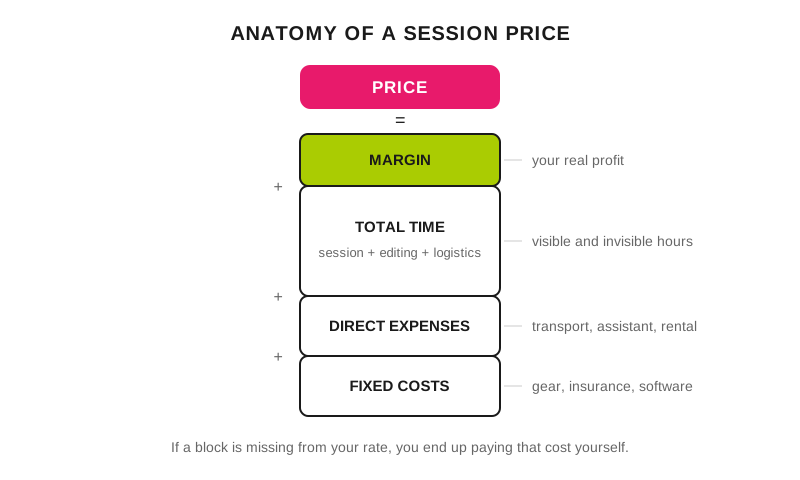
A fair price adds up all your time, expenses and fixed costs, plus your margin.
Your images never stop belonging to you
Many photographers face the same question: how can I sell my photos without losing my rights or giving up more than necessary?
The answer lies in balancing three axes: legal protection, pricing strategy and clarity in the service. Selling a photograph does not mean giving up your authorship or giving away your effort; it means learning to negotiate with knowledge and confidence.
The most common mistake is thinking that once the images are delivered they "stop being yours." Nothing could be further from the truth: copyright arises automatically at the moment of creation and stays with you for your whole life (plus several decades after in most countries).
What you really negotiate with a client is not your authorship, but a license of use: the authorization for that client to use your photos in certain contexts, with certain limitations and for a specific period. Protection terms and registration requirements change from one country to another, so confirm those of the regulations that apply to you.
Having clarity on this point will let you set fair prices, create solid contracts and present your services professionally without fear of losing control over your work.
How do I build the commercial side of the business?
Price structure: costs + time + added value + profit margin.
Commercial portfolio: 15 - 20 images that demonstrate specific capability.
Contracts: clear terms, usage rights, cancellation policies.
Marketing: consistent social media, active networking, client referrals.
What do I need to set up before the first client?
Online presence: professional website, optimized portfolio, good search engine positioning (SEO).
Tools: customer relationship manager (CRM), invoicing software, cloud backup.
Legal: professional insurance, clear terms of service, standard contracts.
Financial: a dedicated business account, a reserve for gear, tax planning.
How do I calculate the price of a session?
Component: Operating costs; What goes in: Gear, insurance, software, transport, website; How you calculate it: Annual total ÷ billable days per year
Component: Real time; What goes in: Session, travel, selection, processing, delivery; How you calculate it: Effective hours × your hourly rate, not just the shooting hours
Component: License of use; What goes in: Scope, territory, duration, exclusivity; How you calculate it: Multiplier on the base rate; exclusivity is charged separately
Component: Production; What goes in: Assistant, studio, props, models, catering; How you calculate it: At cost, with the margin you declare to the client
Component: Margin; What goes in: Reinvestment in gear and a cushion for slow months; How you calculate it: A percentage you decide before quoting, not after
The usual trap is quoting only the first and second components and giving away the third. A product session for a small shop and the same session for a national campaign cost the same to produce and are not worth the same, because what changes is the license. The photography pricing calculator does the first calculation; the breakdown of hourly versus fixed package pricing is in price per hour vs per package.
Common mistakes
Charging very low prices out of insecurity (not sustainable in the long run).
Not defining a specific niche (competing in the general market).
Unrealistic promises to clients (wrong expectations).
Not separating personal finances from the business.
Professional tips
Pricing formula: (operating costs + desired salary) / workable days per year.
Always deliver more value than promised, never less.
Active network: a good share of commissions arrives through referrals from previous work rather than paid advertising. Treat every delivery as the sales material for the next client.
Frequently asked questions
Does selling a photo mean giving up the copyright?
No. Copyright arises with you at the moment of creation and is not transferred by default when you collect an invoice. What you deliver is a license of use, which defines in which media, in which territory, for how long and with what exclusivity the client can use those images. A full assignment of rights exists, it is signed separately and charged separately.
How do I set a price if I am just starting and have no references?
Calculate your floor with the formula of costs and billable days, and do not go below it even if you have no track record. Charging below cost does not win clients, it wins clients who leave as soon as you raise the price. If you need a portfolio, negotiate the scope (fewer photos, fewer uses, shorter license term) before negotiating the rate.
Do I need to register as self-employed to invoice my first photos?
The registration requirements, taxes and income thresholds change completely between Spain, Mexico, Argentina, Colombia, Chile and Peru, so the answer depends on where you are tax resident. What is common to all: separate the business account from the personal one from the first invoice and keep expense receipts, because they are the basis of any deduction.
What should a photography contract include?
At a minimum, five things: what is delivered and when, what uses the license authorizes, what happens if the client cancels, what happens if you cancel, and how and when you get paid. A non-refundable deposit (where your local law allows it) that covers holding the date is what avoids most conflicts, and makes the rest of the contract almost never needed.
Sell your work, not your authorship.
The 44 cards from Enfogram handle the technical side of the assignment so that the time you have left over goes into quoting it well.