Standard Photo Print Sizes
Table of sizes in cm, inches and pixels at 300 ppi: child 2.5x3, ID card, passport, 10x15 postcard, Polaroid, Letter and A4, and the crop for each.
The Mexican child-size photo measures 2.5 × 3 cm, which at 300 ppi is 295 × 354 pixels. The 10 × 15 cm lab print is 1181 × 1772 pixels. With those two figures you solve most of the orders that come across a counter; the rest is in the tables below, with their equivalents in inches and pixels.
The formula that generates all of them is a division: pixels = centimeters ÷ 2.54 × ppi. 300 ppi for something held in the hand, 150 ppi for something viewed hanging from two meters away. If you prefer to enter your own numbers, the print size calculator does the math in reverse: you give it the pixels of your file and it tells you how large it can go.
How many pixels does each print size need?
The commercial formats that any lab in Spain or Latin America prints without asking:
Format: Postcard / 10 × 15; Centimeters: 10 × 15 cm; Inches: 3.9 × 5.9 in; Pixels at 300 ppi: 1181 × 1772; Pixels at 150 ppi: 591 × 886
Format: 13 × 18; Centimeters: 13 × 18 cm; Inches: 5.1 × 7.1 in; Pixels at 300 ppi: 1535 × 2126; Pixels at 150 ppi: 768 × 1063
Format: 15 × 21; Centimeters: 15 × 21 cm; Inches: 5.9 × 8.3 in; Pixels at 300 ppi: 1772 × 2480; Pixels at 150 ppi: 886 × 1240
Format: Letter; Centimeters: 21.6 × 27.9 cm; Inches: 8.5 × 11 in; Pixels at 300 ppi: 2551 × 3295; Pixels at 150 ppi: 1276 × 1648
Format: A4; Centimeters: 21 × 29.7 cm; Inches: 8.3 × 11.7 in; Pixels at 300 ppi: 2480 × 3508; Pixels at 150 ppi: 1240 × 1754
Format: 20 × 30; Centimeters: 20 × 30 cm; Inches: 7.9 × 11.8 in; Pixels at 300 ppi: 2362 × 3543; Pixels at 150 ppi: 1181 × 1772
Format: A3; Centimeters: 29.7 × 42 cm; Inches: 11.7 × 16.5 in; Pixels at 300 ppi: 3508 × 4961; Pixels at 150 ppi: 1754 × 2480
Format: 30 × 45; Centimeters: 30 × 45 cm; Inches: 11.8 × 17.7 in; Pixels at 300 ppi: 3543 × 5315; Pixels at 150 ppi: 1772 × 2657
Format: 40 × 60; Centimeters: 40 × 60 cm; Inches: 15.7 × 23.6 in; Pixels at 300 ppi: 4724 × 7087; Pixels at 150 ppi: 2362 × 3543
Format: 50 × 70; Centimeters: 50 × 70 cm; Inches: 19.7 × 27.6 in; Pixels at 300 ppi: 5906 × 8268; Pixels at 150 ppi: 2953 × 4134
A 24 MP camera delivers 6000 × 4000 pixels, which at 300 ppi gives 50.8 × 33.9 cm. Translated: it covers everything up to 30 × 45 with plenty of margin, and reaches 50 × 70 by dropping to 200 ppi, a density nobody can distinguish at the distance a picture of that size is hung. The detail on why 300 ppi isn't a sacred boundary is in resolution and printing (ppi / DPI).
What size are child, ID card and passport photos?
Here it's worth separating two things. The measurements of a photo for an official document are set by the authority that issues that document, not the lab, and they change from one country to another and from one procedure to another within the same country. What follows are the most requested sizes, not an international standard: confirm the current requirement in the call for applications or on the procedure's official page before wasting paper.
Use: Child size (Mexico); Usual size: 2.5 × 3 cm; Pixels at 300 ppi: 295 × 354; Who decides the size: Lab convention and the institution requesting it
Use: Rectangular ID card (Mexico); Usual size: 3.5 × 4.5 cm; Pixels at 300 ppi: 413 × 531; Who decides the size: Lab convention; ask whether they want it oval
Use: Oval ID card or mignon (Mexico); Usual size: 3.5 × 5 cm; Pixels at 300 ppi: 413 × 591; Who decides the size: Lab convention
Use: Passport, ICAO recommendation; Usual size: 3.5 × 4.5 cm; Pixels at 300 ppi: 413 × 531; Who decides the size: Issuing authority of each country
Use: National ID and passport (Spain); Usual size: 2.6 × 3.2 cm; Pixels at 300 ppi: 307 × 378; Who decides the size: Set by royal decree
Use: US visa and passport; Usual size: 5.08 × 5.08 cm (2 × 2 in); Pixels at 300 ppi: 600 × 600; Who decides the size: US authority
Use: Diploma (Mexico); Usual size: 5 × 7 cm; Pixels at 300 ppi: 591 × 827; Who decides the size: Lab convention and the institution
Use: Degree certificate (Mexico); Usual size: 6 × 9 cm; Pixels at 300 ppi: 709 × 1063; Who decides the size: Lab convention and the institution
The 3.5 × 4.5 cm format is so widespread because it's the one the ICAO recommends for travel documents, and a recommendation is not an obligation: Spain sets 3.2 × 2.6 cm by royal decree and the United States uses a 2 × 2 inch square, which isn't proportional to any of the others. A photo prepared for the Mexican passport doesn't work as is for a US visa: the framing has to be redone.
It's worth saying clearly: as far as we know, no Mexican authority sets the measurements of the child photo, the ID card photo, the diploma or the degree certificate. They are lab conventions. The child size is unanimous at 2.5 × 3 cm, and the diploma and degree certificate are stable at 5 × 7 and 6 × 9, but the ID card photo is sold in two different heights (4.5 cm rectangular and 5 cm oval) depending on the lab and on what whoever requires it asks for. That is the case where a phone call is worth more than a print order. The only Mexican size we know to be published by an authority is the passport's, 4.5 × 3.5 cm, and that procedure no longer always asks for a printed photo: in Mexico and at several consulates, the official takes it during biometric enrollment.
A practical tip that saves money: ID photos are printed on 10 × 15 cm sheets with six or eight copies. Prepare the sheet yourself at 1181 × 1772 pixels and you pay for one print, not eight.
How big is a postcard, a Polaroid and a Letter sheet?
The three formats that cause the most confusion because the name doesn't match a single size:
Postcard. The photographic postcard is the 10 × 15 cm. The stationery postcard follows A6, which measures 10.5 × 14.8 cm. Half a centimeter of difference that does show if you designed to the millimeter.
Polaroid. The classic integral print (600, i-Type, SX-70) measures 8.8 × 10.7 cm overall, but the image area is a 7.9 × 7.9 cm square, 933 × 933 pixels at 300 ppi. The wide white border at the bottom is part of the format, not a margin you can use. An Instax mini is smaller: a 5.4 × 8.6 cm card with a 4.6 × 6.2 cm image.
Letter. 21.6 × 27.9 cm, and it isn't an A4. Compared with A4 (21 × 29.7 cm), Letter is 6 mm wider and 1.8 cm shorter. A file laid out for A4 and printed on Letter loses almost two centimeters at the bottom.
Why doesn't my photo fit the paper exactly?
Because the sensor and the paper have different proportions. A camera with a 3:2 sensor delivers images whose ratio between sides is 1.5, and only some of the usual formats respect that figure: 10 × 15, 20 × 30, 30 × 45 and 40 × 60. Everything else crops.
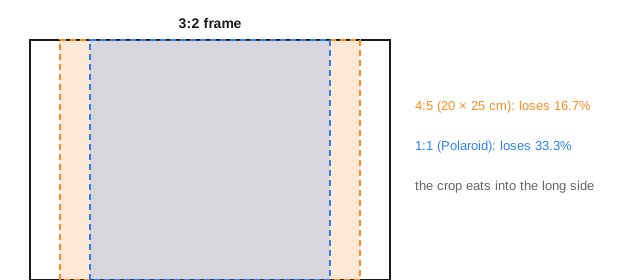
From a 3:2 frame, each squarer format crops the long side.
Format: 10 × 15, 20 × 30, 30 × 45 and 40 × 60 cm; Ratio: 1.50; From a 3:2: Fits exactly; Long-side crop: 0%
Format: A4 and A3; Ratio: 1.41; From a 3:2: Crops; Long-side crop: 5.7%
Format: 13 × 18 cm; Ratio: 1.38; From a 3:2: Crops; Long-side crop: 7.7%
Format: 30 × 40 cm; Ratio: 1.33; From a 3:2: Crops; Long-side crop: 11.1%
Format: Letter; Ratio: 1.29; From a 3:2: Crops; Long-side crop: 13.9%
Format: 20 × 25 cm; Ratio: 1.25; From a 3:2: Crops; Long-side crop: 16.7%
Format: Polaroid, 1:1; Ratio: 1.00; From a 3:2: Crops; Long-side crop: 33.3%
That 16.7% of the 20 × 25 is the reason so many portraits come back from the lab with the top of the head cut off: the operator crops from the center because it's the only thing they can do. Crop yourself before sending and you decide what goes.
How to prepare the file before sending it to the lab
Crop to the final proportion, not to the size in centimeters. A 3:2 for a 20 × 25 has to be taken to 4:5 in the editor.
Always export with the pixels from the table as a minimum. If the file falls short, lower the density rather than enlarge: real 200 ppi looks better than interpolated 300 ppi.
Leave 3-5 mm of air around the subject if the paper is cut to bleed. The guillotine isn't millimeter-precise.
Send in sRGB unless the lab asks for another color space in writing; that is the detail that explains dull skin tones when you pick up the order, and it's developed in color profile.
Name the files with the size:
retrato_20x30.jpg. When you send twelve, this avoids the wrong order, and it fits with the file management and workflow guide.
If you're also going to charge for those prints, the margins and formats worth offering are in printing and selling photos: sizes and quality.
Frequently asked questions
How many megapixels do I need to print at 30 × 45 cm?
At 300 ppi you need 3543 × 5315 pixels, which is 18.8 MP. At 200 ppi you drop to 2362 × 3543 pixels, 8.4 MP, and at the distance a picture of that size is viewed the difference isn't visible. Any camera of 20 MP or more covers the case without cropping.
Can I print a phone photo at 10 × 15 cm?
Yes, with room to spare. A 12 MP phone delivers 4032 × 3024 pixels, and the 10 × 15 calls for 1181 × 1772: more than double is left over on each side. That same file reaches 34 × 25.6 cm at 300 ppi.
Is Letter size the same as A4?
No. Letter measures 21.6 × 27.9 cm and A4 measures 21 × 29.7 cm, so Letter is wider and shorter. A design made for A4 and printed on Letter loses 1.8 cm of height, usually at the bottom edge.
My file says 72 ppi. Will it print badly?
Not necessarily. The ppi value saved in the file is a label, not image information: all that matters is the total pixels. A 1181 × 1772 pixel file labeled 72 ppi prints just as well at 10 × 15 cm when you specify 300 ppi in the print dialog.
What to check before going to the lab
Three checks, in this order: the crop proportion, the pixels of the short side against the table, and, if it's an ID photo, the current official requirement for the procedure, which is the only thing on this page that may have changed since you read it.
The 44 Enfogram cards have the sizes, settings and tables that take up a screen here printed on them, in A4 and A5, so you can consult them without searching for anything.