Natural Light Basics for Photographers
Natural light constantly changes in quality, direction and intensity. There is no "bad light," only light unsuited to what you are trying to communicate.
Between midday sun and golden hour there are about three stops of difference: f/11 at 1/250 s with ISO 100 in direct sun, f/2.8 at 1/1000 s with ISO 200 when the sun grazes the horizon. What changes between the two is not only the amount of light; the direction and hardness of the shadow change, and that decides the photo long before the setting does.
Natural light constantly changes in quality, direction and intensity. Each moment of the day offers unique characteristics you can use creatively. There is no "bad light," only light unsuited to what you are trying to communicate. Understanding light means observing how it interacts with your subject and choosing the moment that best serves your artistic vision.
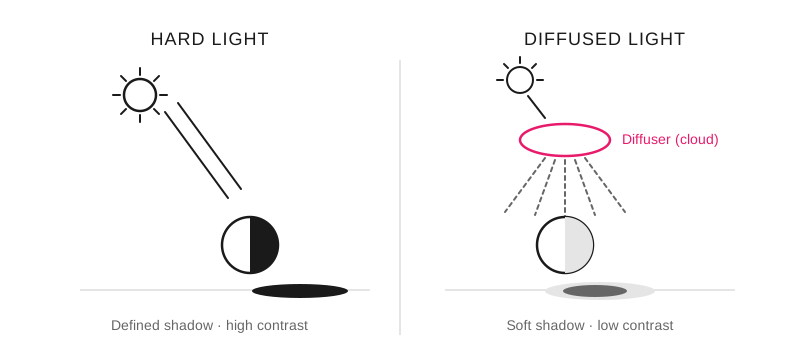
Direct light produces hard, defined shadows; a diffuser (like clouds) softens it and reduces contrast.
What is the difference between hard light and diffused light?
Hard light: hard or raw light is light that reaches the subject directly without any filter or modifier, giving a very marked contrast between the lit area and the shaded area.
Diffused light: diffused or soft light reaches the subject through bounces from surfaces such as walls, floor, large windows, etc., or through a filter (clouds, a semi-translucent object), which gives us less contrast between the lit area and the shaded area.
We must not get confused. The quality of light has nothing to do with quantity. Hard light is usually associated with a lot of light and diffused light with little light. Our light source can be a low-intensity lamp with a hard-light finish. The sun through a cloud can be a lot of light but reaches us as diffused light. The glossary entry on hard light and soft light develops how the relative size of the source decides the edge of the shadow.
What light does each moment of the day give?
Golden hour (near sunrise or sunset): warm, soft, directional light, perfect for emotional portraits.
Side window light: creates dramatic modeling in portraits, ideal for highlighting textures.
Overcast day: diffused light, muted colors, perfect for natural portraits.
Creative backlight: expressive silhouettes, halos of light, ethereal atmospheres.
The golden hour window doesn't last the same in Madrid as in Bogotá, and in summer it doesn't last the same as in January. The golden hour calculator returns the exact time for your location and date instead of making you estimate it.
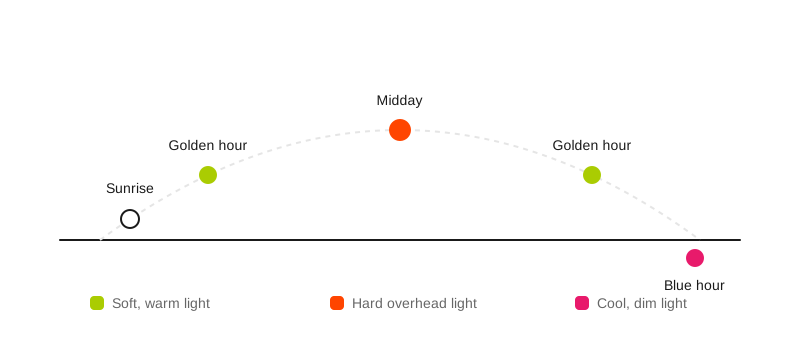
The sun's path defines the quality of light: soft and warm in the golden hours, hard at midday and cool in the blue hour.
What settings do I use in each scene?
Golden hour: ISO 100–400, aperture according to the desired depth of field, compensation +0.3 to +0.7 relative to the meter reading.
Hard midday light: look for open shade, use a reflector or fill flash.
Indoors with a window: place the subject at 45° to the window, reflector on the shadow side.
Backlight: spot metering on the subject, accept overexposure of the background.
The seven starting points in the table are calculated with the same criterion, so the last column (EV at ISO 100) lets you compare them without recalculating anything. The check is the sunny 16 rule: direct midday sun is EV 15, which is equivalent to f/16 at 1/125 s at ISO 100.
Scene: Direct sun, midday; Light quality: Hard, overhead, short shadows; ISO: 100; Aperture: f/11; Shutter speed: 1/250 s; EV (ISO 100): 15
Scene: Open shade at midday; Light quality: Diffused, enveloping; ISO: 100; Aperture: f/5.6; Shutter speed: 1/125 s; EV (ISO 100): 12
Scene: Fully overcast day; Light quality: Diffused, no clear direction; ISO: 400; Aperture: f/5.6; Shutter speed: 1/500 s; EV (ISO 100): 12
Scene: Golden hour, portrait; Light quality: Warm and very directional; ISO: 200; Aperture: f/2.8; Shutter speed: 1/1000 s; EV (ISO 100): 12
Scene: Backlight at sunset, metered on the face; Light quality: Hard rim light, halo in the hair; ISO: 200; Aperture: f/2.8; Shutter speed: 1/500 s; EV (ISO 100): 11
Scene: Side window, subject at 1 m; Light quality: Diffused and directional; ISO: 400; Aperture: f/2.8; Shutter speed: 1/250 s; EV (ISO 100): 9
Scene: Blue hour, 15 min after sunset; Light quality: Dim, cool, flat; ISO: 800; Aperture: f/4; Shutter speed: 1/30 s; EV (ISO 100): 6
Every row costs something. At f/2.8 in golden hour you have a few centimeters of sharpness and the far eye goes soft. At ISO 800 in the blue hour, grain appears in smooth skies. And 1/30 s handheld means half the shots will come out blurred: for that last row, a tripod, not a steady hand.
Common mistakes
Avoiding midday light completely (it has specific creative uses).
Not observing the direction of the light before positioning the subject.
Using automatic flash that "kills" the effects of the existing natural light.
Not taking advantage of natural reflective surfaces (white walls, snow, water).
The first is the most expensive, because it cancels five hours of every day. How to work with very hard shadows is developed in hard midday light.
Pro tips
Always carry a folding 5-in-1 reflector, to use as a main light or to fill shadows.
Make the most of the last hour of light before sunset and the first hour after sunrise.
On days of intense sun, look for open shade to work with more diffused light.
Frequently asked questions
How long does golden hour really last?
Almost never an hour. At mid-latitudes (Spain, northern Mexico, central Argentina) it lasts between 30 and 60 minutes depending on the season; near the equator the sun drops almost vertically and the window shrinks to 20 minutes or less. The golden hour calculator gives the exact interval for your city and date, which is the only way to plan a session without arriving late.
Can you do a portrait at midday in harsh sun?
Yes, by moving the subject into open shade: the eave of a building, an arcade, the shade of a large tree. That drops the scene from EV 15 to EV 12 and puts it at ISO 100, f/5.6 and 1/125 s, with a diffused light that wraps the face. The alternative is to leave them in the sun and fill the shadow with a reflector or flash.
Why does my subject come out black when backlit?
Because matrix metering averages the bright background and exposes for it, leaving the face three or four stops under. Switch to spot metering on the lit cheek: the face comes out right and the background goes white, which is the price of backlight. In the guide to strategic light metering you will find the three metering modes and when to use each.
How far from the window do I place the subject?
The closer, the softer and the faster the light falls off: going from 1 m to 2 m from the window you lose two stops of intensity, and those two stops have to be recovered with ISO or shutter speed. At 1 m you have marked modeling with fast falloff toward the dark side; at 3 m the lighting is flatter and more even between two people.
Overcast or sunny for a portrait?
Overcast, almost always. A covered sky is a window the size of the sky: no harsh shadows under the eyes, no squinting and two hours straight of stable light instead of twenty minutes. Direct sun wins only when you are after backlight or a strong graphic shadow.
What to look at before placing the subject
Three things, in this order: where the light comes from (turn your back to it and look at the shadow of your own hand), whether the edge of that shadow is sharp or blurred, and what is behind the subject when you turn them toward the light. The settings come afterward and come from the table.
The 44 cards from Enfogram have this scene table printed on them (ISO, aperture, shutter speed and EV), so you can consult it with the sun going down and without taking out your phone.