Narrative Landscape Photography
Contemporary landscape goes beyond the postcard: it tells stories about the place, the era and the human relationship with the environment.

ISO 100, f/8 - f/11 and a tripod cover almost all golden hour landscape; arriving 45 minutes early covers the rest. At f/11 and ISO 100 with golden hour light (roughly EV 12) the shutter speed you get is around 1/30 s, and there the tripod stops being a preference.
Contemporary landscape goes beyond the pretty postcard: it tells stories about the place, the era, the human relationship with the environment. Technique is learned in an afternoon; personal vision is what distinguishes your work. Every landscape has multiple interpretations depending on your perspective and chosen moment.
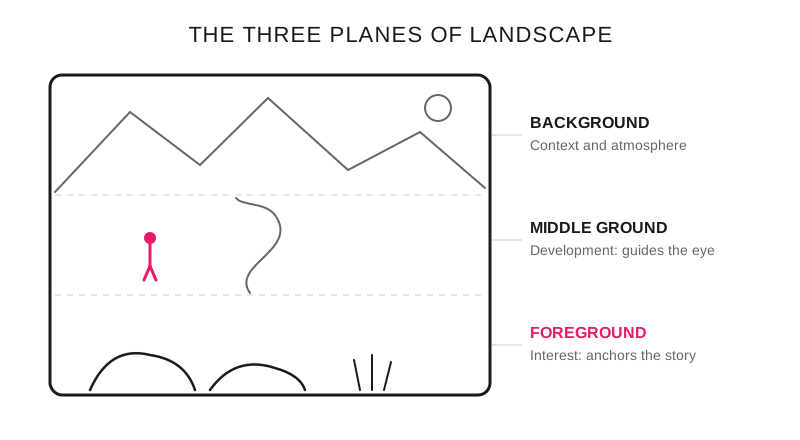
The foreground anchors, the middle ground develops and the background gives context; a human figure adds scale.
What turns a postcard into a story?
Golden hour: from 30 minutes before sunrise or sunset and for as long as that golden color in the sky lasts is usually the best time to photograph this type of landscape. At this time of day, the contrast range decreases, shadows deepen, textures become prominent and the whole scene takes on saturated tones of color.
Use people: add people to a landscape photograph to emphasize scale, create a story and help the viewer empathize with the image. Make sure to place the person so they stand out from the surroundings (bright clothing, silhouette, etc.).
Use reflections: when the landscape is reflected on a surface such as water, it adds symmetry and enhances the magnitude and dynamics of the scene. Calm days work better than windy days, since the water will give a smoother reflection on the glassy surface.
At what height do I place the camera?
We are used to seeing everything at eye level. Placing the camera from a high vantage point or close to the ground gives it a creative touch.
Do not wait for the weather to improve
Often the sky before or after a storm can provide spectacular light and unusual clouds. Overcast days, fog, snow and rain give atmospheres that a blue sky does not.
What type of landscape am I making?
Epic landscape: wide angle, f/11, hyperfocal focus, dramatic foreground.
Intimate/detail: telephoto, f/8, isolation of specific elements.
Minimalist: any focal length, simple composition, ample negative space.
Narrative: include subtle human elements, the story of the place.
What settings do I use in each scene?
Scene: Epic landscape with foreground; Focal length (full frame): wide angle, 16 - 35 mm; Aperture: f/11; ISO: 100; Support and shutter speed: tripod, hyperfocal focus
Scene: Intimate detail; Focal length (full frame): telephoto, 70 - 200 mm; Aperture: f/8; ISO: 200 - 400; Support and shutter speed: handheld if there is light, single point
Scene: Golden hour; Focal length (full frame): whatever the scene calls for; Aperture: f/8 - f/11; ISO: 100; Support and shutter speed: tripod mandatory, around 1/30 s
Scene: Overcast day; Focal length (full frame): whatever the scene calls for; Aperture: f/8; ISO: 200 - 400; Support and shutter speed: handheld, around 1/125 s
Scene: Silky water or moving clouds; Focal length (full frame): any; Aperture: f/11; ISO: 100; Support and shutter speed: 3 - 6 stop ND filter and tripod
On an overcast day (EV 12) with f/8 and ISO 200 the shutter speed comes out near 1/125 s, which is why that is one of the few scenarios in the table where the tripod is unnecessary. The stops each density takes away are calculated by the ND filter calculator, and the exact time that light starts at your location by the golden hour calculator.
The mistakes that ruin a sunrise
Including too many elements without a clear visual hierarchy.
Using wide angle for everything (you lose the intimate detail).
Not considering weather conditions as a creative element.
Automatic focus at infinity without verifying real sharpness.
Professional tips
Hyperfocal focus rule: calculate the distance before sunrise with the hyperfocal calculator, not with the sun coming up.
Carry an augmented reality app to predict the sun/moon position.
In the mountains, use a telephoto to compress planes and create abstractions.
Light, moment and point of view build the narrative.
Frequently asked questions
How long does golden hour really last?
It does not last a fixed hour: at mid latitudes it is between 30 and 60 minutes around sunrise and sunset, near the equator it can be as short as 20 minutes and in summer at high latitudes it stretches for hours. It depends on your latitude and the date, so it is best to look it up for the specific day instead of estimating it.
What aperture do I use for landscape?
Between f/8 and f/11 on full frame: that is where most lenses perform best and where depth of field is enough for a close foreground and a distant background. Stopping down beyond f/16 starts to cost sharpness through diffraction, and that lost detail cannot be recovered by sharpening in processing.
Where do I focus to get it sharp from front to back?
At the hyperfocal distance, not at infinity. With a 24 mm at f/11 on full frame, the hyperfocal distance is around 1.75 m: focusing there you have acceptable sharpness from about 87 cm to infinity, while focusing at infinity wastes the entire near half of the frame.
Do I need an ND filter for water?
Only if you want speeds of seconds in daylight. For the silky effect on a river you need between 3 and 6 stops of density, and with the fading light of a sunset you sometimes already reach 1/2 s at f/11 and ISO 100 with no filter at all; first check the speed the scene gives and buy stops only if you are short.
What to bring to your next sunrise
The tripod, the hyperfocal distance calculated the night before and an idea of what the place says beyond being pretty. The composition of the foreground with the background (the order that makes the frame readable) is developed in the dynamic visual composition guide and in narrative landscape.
The 44 cards from Enfogram have these settings by scene printed on them, so you can read them with a headlamp while you set up the tripod in the dark.