Low-Light Photography
Having little light is not a problem, it's a creative opportunity. The key is balancing ISO, aperture and shutter speed to match your creative vision.

With f/1.8 and ISO 800 in a home interior at night, the shutter speed you get is 1/80 s. There the photo still holds up handheld with a 50 mm; below 1/30 s by hand, half the shots will come out blurred and no setting fixes that, only a support.
Having little light is not a problem, it's a creative opportunity. Your camera sees differently from your eyes, but with the right technique you can capture atmospheres that are impossible and far from the documentary gaze. Balance ISO (noise), aperture (depth of field) and shutter speed (perception of motion) according to what you want to tell.
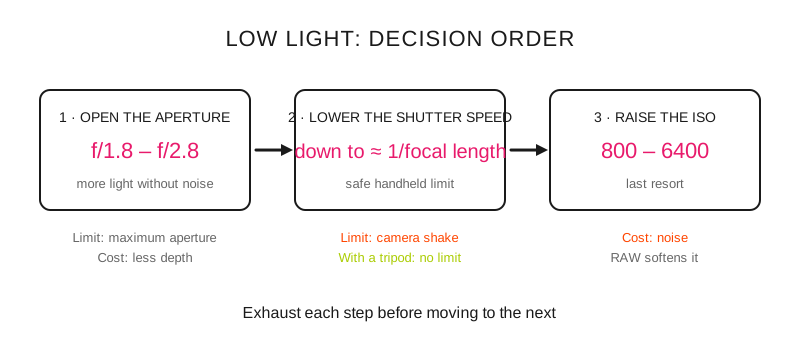
Decision chain in low light: gain light first where the cost to the image is lowest.
What equipment do I need in low light?
Camera: The best option is a lens with an aperture of f/2.8 or wider. Image stabilization (in the camera, the lens or both) is a great advantage.
External flash: Important if the ambient light is insufficient or unsuitable.
Tripod: Necessary if you are going to use very slow shutter speeds, to avoid camera shake.
Remote release: Shooting without direct contact with the camera becomes necessary when even pressing the shutter button can cause blurred images, because you are working with very low speeds.
What settings do I use in each scene?
Scene: Interior with a window, daytime; Approx. light: EV 9; Aperture: f/2.8; ISO: 400; Shutter speed: 1/250 s; What it costs: nothing: it's the easy scene
Scene: Home interior at night; Approx. light: EV 5; Aperture: f/1.8; ISO: 800; Shutter speed: 1/80 s; What it costs: 17 cm of sharpness with a 50 mm at 2 m
Scene: Street at night with streetlights; Approx. light: EV 4; Aperture: f/2; ISO: 3200; Shutter speed: 1/125 s; What it costs: visible noise in the shadows
Scene: Stage with spotlights; Approx. light: EV 6; Aperture: f/2.8; ISO: 3200; Shutter speed: 1/250 s; What it costs: noise and changing light color
Scene: Table with candles; Approx. light: EV 2; Aperture: f/1.8; ISO: 6400; Shutter speed: 1/80 s; What it costs: high noise and critical focus
The five light values are measured at ISO 100 and the rows are consistent with each other: every time you raise ISO by one stop you can gain a stop of shutter speed or stop down the aperture one stop. If you prefer to reorder that combination (more depth of field in exchange for more noise, for example) the equivalent exposures calculator gives all the alternatives for the same exposure.
A / Av aperture priority: Use Av mode and choose the widest possible aperture to let in the most light, or use manual mode.
Slow shutter speed: With low or slow speeds more light comes in. However, this can also cause blurred or smeared images. To avoid it you need a tripod and, sometimes, a remote release.
Exposure compensation: In automatic exposure modes (Av, Tv or P), compensate positively or negatively depending on the result the exposure reading gives.
High ISO + RAW: Raising the ISO also raises the exposure. Shoot in RAW format and if noise appears, it can be corrected in post-processing.
What mode do I leave the camera on?
A/Av mode: controls depth of field, the camera adjusts the shutter speed.
Image stabilization: gains 2 to 3 stops of exposure.
Focus: manual or AF with an AF assist light.
White balance: manual according to the dominant light source.
The mistakes that raise noise unnecessarily
Using automatic flash (it destroys the natural atmosphere).
Raising ISO to the maximum without need (unnecessary noise).
Looking for "safe" shutter speeds when the tripod is available.
Not taking advantage of existing light sources.
Pro tips
Embrace the grain: well-used noise adds character to the image.
Favorite low-light setting: f/1.8, ISO 800, variable shutter speed.
Use an exposure compensation of approx. +0.7 in interiors to avoid underexposure.
When you master light you master the image.
Frequently asked questions
How high can I raise the ISO?
Raise it to whatever ISO you need to get the shutter speed that freezes what moves: a photo with noise gets published and a blurred photo doesn't. As an order of magnitude, most current sensors give perfectly usable files at ISO 3200 and acceptable ones at 6400, but the real limit depends on your camera and the size at which you will display the image, so it is worth measuring it once with your own gear and writing it down.
What is the minimum handheld shutter speed?
The reciprocal rule gives the starting point: 1 divided by the focal length, that is, 1/50 s with a 50 mm and 1/100 s with a 100 mm, on full frame. With stabilization you gain 2 to 3 stops over that figure, but it only compensates for your shake: if the subject moves, the speed is set by the subject and no stabilizer helps.
Do I use flash or raise the ISO?
Raise the ISO when you want to preserve the atmosphere of the existing light, which is usually the reason you are photographing that scene. Use flash when the ambient light is simply insufficient or ugly (an overhead fluorescent, for example) and in that case bounce it, because direct on-camera flash erases precisely what you were going to photograph.
Why does autofocus fail at night?
Because the system needs contrast to detect focus and in dim light there is little. Aim the focus point at a high-contrast edge (the edge of a streetlight, the outline of a face against a light wall), use the assist light if the scene is close, or switch to manual with on-screen magnification, which ends up being faster.
What to check before shooting in dim light
The minimum shutter speed your focal length can handle, the ISO you have decided as a ceiling and whether you have somewhere to rest the camera. The complete ISO strategy by scene is in the smart ISO guide, and when the scene goes from dim light to full night, the terrain is that of the night photography guide and of low light without noise.
The 44 Enfogram cards come with this table of scene, aperture, ISO and shutter speed printed, so you can consult it in the dark without turning on the screen.