Documentary Photography: Telling What Happens
What separates documentary from photojournalism, how a photo essay is structured, and street and indoor settings measured for full frame.
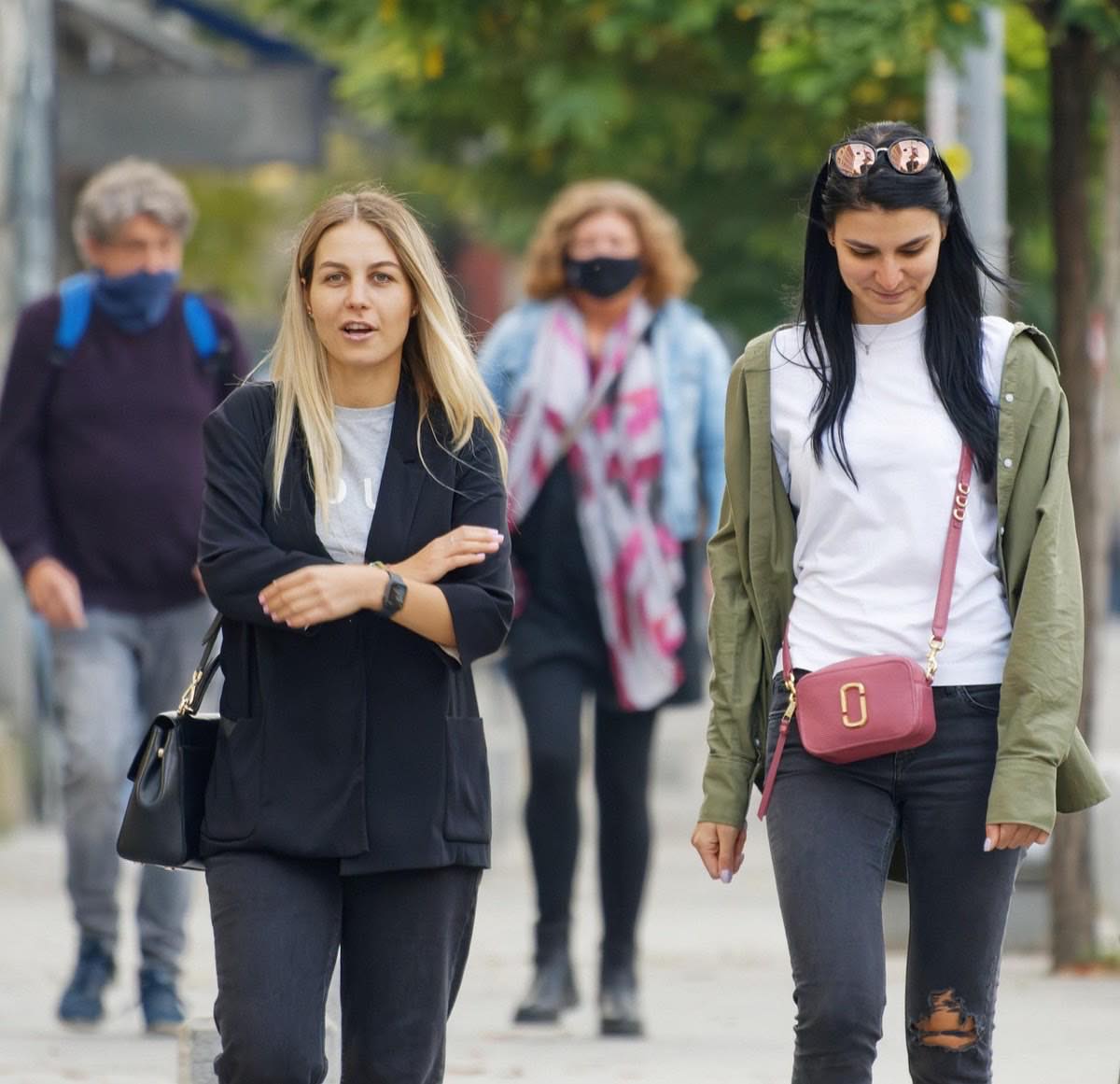
A 35 mm at f/8 focused at 3 m keeps everything sharp from 1.9 m to 7.2 m on full frame: that is an entire documentary project solved without touching the focus. When the scene doesn't repeat, reaction speed is worth more than maximum aperture, and the best way to be fast is not having to decide anything. Fix the aperture, fix the distance, leave ISO on auto and devote your head to looking.
What sets the genre apart is not the gear but the duration. A news report is made in a day; a documentary work is made by going back.
How does it differ from street photography and photojournalism?
In the assignment, the deadline and the minimum unit of result.
| Documentary | Photojournalism | Street photography | |
|---|---|---|---|
| Unit of result | The body of work | The image that illustrates the news | The single image |
| Timeframe | Months or years | Hours | This afternoon's walk |
| Origin of the subject | Chosen by the author | Assigned by current events | Found |
| Relationship with the subject | Ongoing, with negotiated access | Brief, coverage-based | Usually none |
| Editing | Sequence and supporting text | Caption | None needed |
| Manipulation allowed | None in the content | None in the content | Free |
The border with street photography is porous in technique and sharp in intent: the documentarian goes back to the same place forty times and the street rarely comes back twice. And the border with art photography lies in the commitment to the fact: the moment you move an object so it composes better, you have changed genres, even if the photo improves.
What settings do I use when you can't repeat the scene?
Aperture priority fails in documentary work because the shutter speed sinks without warning. Manual with auto ISO, or shutter priority with an ISO cap, keep fixed what you can't afford to lose.
Scene: Street in full sun; Focal length: 35 mm; Aperture: f/8; Shutter speed: 1/500 s; ISO: 100; What it costs: Closed-up shadows; expose for the highlights
Scene: Overcast street; Focal length: 35 mm; Aperture: f/5.6; Shutter speed: 1/250 s; ISO: 200; What it costs: 1/250 s doesn't freeze a gesturing hand
Scene: Indoors by day, away from the window; Focal length: 35 mm; Aperture: f/2; Shutter speed: 1/125 s; ISO: 800; What it costs: about 40 cm of sharpness at 2 m: the second face misses
Scene: Lit street at night; Focal length: 35 mm; Aperture: f/2; Shutter speed: 1/125 s; ISO: 800; What it costs: Mix of color temperatures
Scene: Indoors at night, one lamp; Focal length: 35 mm; Aperture: f/2; Shutter speed: 1/60 s; ISO: 800; What it costs: At 1/60 s everything that talks moves
Scene: Dimly lit bar; Focal length: 35 mm; Aperture: f/2; Shutter speed: 1/60 s; ISO: 3200; What it costs: Obvious grain and shadows without detail
The six rows are consistent with each other: if you change one parameter, the table tells you how much to compensate in the other two. The equivalent exposure calculator does that math when the scene in front of you falls between two rows.
The limit worth accepting from the start: below 1/60 s with a handheld 35 mm, some of the shots will come out blurred and no stabilizer fixes it, because what moves is the subject and not the camera. In dark interiors, choose high ISO over a low shutter speed; grain you can live with, sweep you can't.
On focus: zone focusing keeps winning in fast scenes. With a 35 mm at f/8 the hyperfocal distance on full frame falls at 5.1 m, and focusing there you have everything sharp from 2.55 m to infinity. You set that once in the morning and never think about focus again.
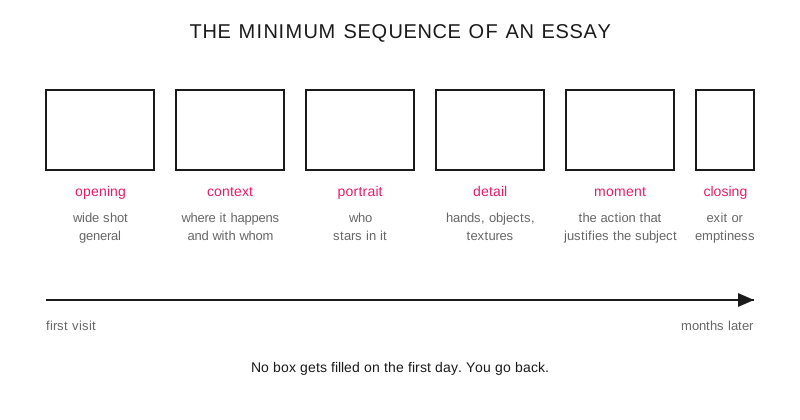
Six boxes that any editor looks for in an essay. If you're missing one, you know exactly what to go photograph tomorrow.
How a documentary project is built
Start with a sentence, not a photo. If you can't say what your work is about in one sentence with a subject and a verb, you don't have a project yet: you have a theme, and themes never run out.
Then, five decisions that save months:
Define the place and time. "The last fishermen of a specific harbor during one season" can be finished. "Artisanal fishing" can't.
Set a visiting cadence. One day a week for six months produces more usable material than two weeks in a row.
Edit every month, not at the end. Seeing the gaps in time is what directs the next visit.
Write while you photograph. Names, dates, what was said. A correct caption six months later depends on a notebook, not on memory.
Look for the six boxes in the diagram above: opening, context, portrait, detail, moment and closing. A sequence stands on those; without the portrait or without the detail, it falls.
The medium shot is the workhorse of the genre (it shows the person and some of their surroundings), but an entire sequence of medium shots reads as monotonous. Alternate with at least one wide shot and one detail for every three.
Access: arriving, staying, disappearing
Good material begins when they stop looking at the camera, and that happens through accumulated hours, not technique.
Introduce yourself and explain the project on the first visit. Without a camera if needed.
Go back without photographing once. It changes the relationship disproportionately.
Show results to the people portrayed before anyone else. A flash drive with twenty photos opens doors that no accreditation opens.
Let them know when the project is published. If someone appears in an image, they have the right to know where it will be.
On permissions: photographing in public and publishing an identifiable image are different things, and the rules change by country. Spain, Mexico, Argentina, Colombia, Chile and Peru treat the right to one's own image with different criteria, and editorial use is not governed the same as commercial use. Check the regulations of your country and, for work that will be published, the guide to legal aspects and copyright gathers the concepts you need to handle before asking.
Ethics: what can be moved and what can't
The genre's rule is short: you can choose where you stand; you can't change what happens.
It is accepted to frame, wait, come back another day, adjust exposure, contrast and white balance, and crop without altering the meaning. It is not accepted to ask someone to repeat a gesture and present it as spontaneous, to add or remove elements in editing, or to combine two moments in a single image.
The borderline case is the posed portrait within an essay. It is legitimate, as long as the sequence and the caption make clear that the person posed. The problem is not the pose: it is passing it off as something else. When the intervention on the scene becomes the material of the work, the work crosses into other territory, and that territory is described in art photography.
Frequently asked questions
What gear do I need for documentary photography?
A camera you can carry all day and a 35 mm prime on full frame, or its 23 mm equivalent on APS-C. Useful coverage is achieved with two focal lengths at most, and adding a third lens usually costs more moments lost changing than frames gained.
How long does a documentary project last?
As long as it takes for a change to appear in what you are photographing: a season, a school year, a pregnancy, a construction project. As a practical reference, if you haven't gone back to the same place at least ten times, you are still in the reconnaissance phase and not in production.
Can I publish photos of people without their permission?
It depends on the country, the context and the use. Informational or editorial use usually receives different treatment from commercial use, but the criteria change between Spain and each Latin American country, so check the regulations of yours before publishing and get written authorization when the person is identifiable and the main subject.
Can documentary be done in black and white?
Yes, and it is as valid a style decision as any other as long as it is applied to the whole series. Mixing color and black and white within the same essay breaks the reading of the sequence and makes the viewer ask why, which is attention you take away from the subject.
What to bring on the first day of a project
A notebook, a 35 mm, the camera in manual with f/8, 1/500 s and auto ISO capped at 3200, and the sentence that describes the project written on the first page. When you get home, sort the shots into the six boxes of the sequence and mark which one is empty: that is the list for the next visit.
The 44 Enfogram cards come with the settings per scene and the zone-focusing distances printed on them, to solve the exposure without lowering the camera.