Street Photography and Candid Capture
Street photography captures decisive moments that reveal the human condition. Reaction, anticipation and invisibility matter as much as technique.

Head out with the camera already set to 35 mm, f/8, 1/1000 s and ISO 200 with the focus fixed at 5.1 m: that gives you sharpness from 2.6 m to infinity and all that is left is to raise the camera and shoot. It is the setting for a sunny day on full frame; the table below has the rest of the scenes. Adjusting in the moment costs two seconds, and the moment lasts less.
Street photography captures decisive moments that reveal the human condition. It is instant visual journalism. Reaction speed, anticipation and social invisibility are as important as technique. Your gear should be a natural extension of your vision, letting you shoot instinctively without missing the moment.
How do you anticipate a moment on the street?
Street photography is not a genre for absolute control, since there are no prepared sets, no lighting control and no rehearsed poses.
What matters is quick adaptation and honest narrative. Scenes that appear and disappear in seconds, people who tell stories with a gesture or a crossing of glances, and atmospheres that change in the blink of an eye.
The street demands anticipation and discretion from the photographer, and offers rhythm, layers and unexpected situations. The goal is to shoot with intention to produce an honest and respectful visual narrative. In practice you anticipate the opposite of how it seems: you choose the background and the light first, and wait for someone to enter the frame.
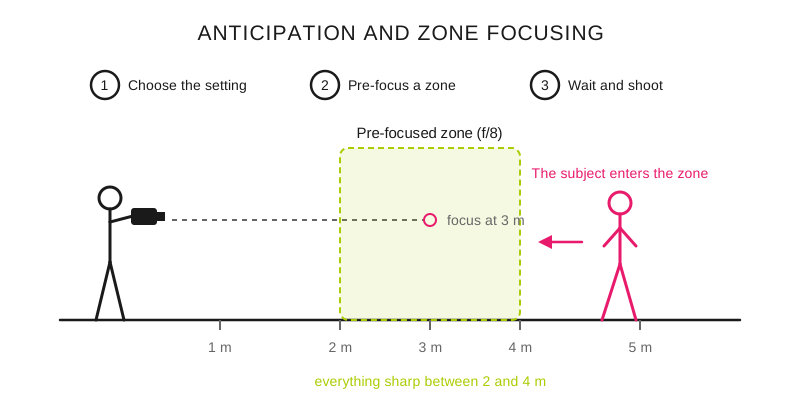
Choose the background, pre-focus a zone at f/8 and wait: when the subject enters, all that is left is to shoot.
What settings do I use in each street situation?
Decisive moment: preset the exposure, continuous focus, fast shooting.
Candid portrait: telephoto, f/4 – f/5.6, high ISO to use fast shutter speeds.
Wide scene: wide angle, f/8 – f/11, hyperfocal focus, everything sharp.
The five scenarios that cover almost any outing, measured on full frame:
Scene: Street in full sun; Focal length: 35 mm; Aperture: f/8; Shutter speed: 1/1000 s; ISO: 200; Light (EV at ISO 100): 15; Sharp zone: 2.6 m → ∞ (focus at 5.1 m)
Scene: Arcades and open shade; Focal length: 35 mm; Aperture: f/8; Shutter speed: 1/250 s; ISO: 400; Light (EV at ISO 100): 12; Sharp zone: 2.6 m → ∞ (focus at 5.1 m)
Scene: Wide scene, overcast day; Focal length: 28 mm; Aperture: f/11; Shutter speed: 1/250 s; ISO: 400; Light (EV at ISO 100): 13; Sharp zone: 1.2 m → ∞ (focus at 2.4 m)
Scene: Candid portrait with a telephoto; Focal length: 85 mm; Aperture: f/4; Shutter speed: 1/1000 s; ISO: 800; Light (EV at ISO 100): 11; Sharp zone: 29 cm deep with the subject at 3 m
Scene: Night under streetlights; Focal length: 35 mm; Aperture: f/2; Shutter speed: 1/250 s; ISO: 3200; Light (EV at ISO 100): 5; Sharp zone: 89 cm deep with the subject at 3 m
The first row is the check of the sunny 16 rule: f/8 at 1/1000 s at ISO 200 is the same light as f/16 at 1/125 s at ISO 100, EV 15. And every row exacts its price: at ISO 3200 the grain is visible in the dark areas of the asphalt, and at f/8 with 1/250 s in shade a cyclist crossing comes out with blurred legs.
What gear and shooting mode do I choose?
Lens: 35mm or 50mm for natural perspective and discretion.
Mode: Aperture Priority, auto ISO with a 1600 – 3200 limit.
Focus: dynamic zone or continuous, focus decoupled from the shutter button.
Shooting: silent if available, short burst for micro-variations.
With the aperture closed down to f/8 there is an alternative faster than any autofocus: zone focusing, which consists of fixing the focus at the hyperfocal distance and never touching it again. The step-by-step procedure is in zone focusing: focus at f/8 without looking, and the hyperfocal calculator gives the distance for your format and focal length.
Common mistakes
Being too obvious makes you lose the naturalness of the moment.
A slow setup makes you miss opportunities because of technical adjustments.
Not respecting people's privacy and dignity.
Looking only for "poverty" or "exoticism" instead of an honest gaze.
Professional tips
Ethical rule: photograph the way you would like to be photographed.
Set the camera up completely before arriving at the location.
Use the hip-shooting technique for greater discretion in sensitive situations.
Frequently asked questions
Is it legal to photograph strangers on the street?
It depends on the country and the differences are large: what is lawful in a public space in one place may require consent in another, and publishing or selling the image is almost always governed by different rules from those for simply taking it. Check the regulations of your country before publishing, and even more so before commercializing. The general criteria and the difference between editorial and commercial use are in the guide to legal aspects and copyright.
What focal length is best for street photography?
35 mm on full frame, almost always. It takes in enough context for it to be clear where the scene happens and forces you to get within 2 or 3 m, which is the distance at which the street looks honest. The 50 mm isolates a figure better from the chaos of the background and the 28 mm takes in too much ground and sky unless you are very close.
How do I focus fast enough when the scene lasts a second?
With fixed focus, not autofocus. A 35 mm at f/8 focused at 5.1 m leaves everything sharp from 2.6 m to infinity on full frame, so anything that happens beyond 2.6 m from you is already in focus before you raise the camera. It is the only technique that completely eliminates focus lag.
What do I do if someone gets upset because I took their photo?
Stop, show them the photo and explain in a sentence what interested you about the scene; if they insist, delete it in front of the person. No image justifies a conflict on the street, and most situations are defused simply by not running away. The ethical lines and borderline cases are covered in street photography: rights and ethics.
Can you do street photography with a phone?
Yes, and it is the most discreet camera there is. The limit appears at night: under streetlights, with the scene at EV 5, a phone applies noise reduction and shot fusion that smears whoever is walking, whereas a camera with an f/2 lens freezes at 1/250 s. By day, the technical difference is much smaller than the difference between being and not being on the spot.
The settings you leave on before heading out
Aperture mode at f/8, auto ISO with a ceiling of 3200, minimum shutter speed 1/250 s, focus fixed at the hyperfocal distance and silent shooting. If you leave home like that, the only decision left to you on the street is where to stand, which is the only one that matters.
The 44 Enfogram cards come with these pre-focus distances and their exposures printed, so you can set them before heading down to the street.
Anticipating is as important as shooting.