Camera Sensor Sizes Compared
Real measurements in millimeters of full frame, APS-C, Micro 4/3 and 1-inch, with the crop factor calculated and what each format gains or loses.
A full-frame sensor measures 36 × 24 mm; an APS-C, about 23.5 × 15.6 mm; a Micro 4/3, 17.3 × 13 mm. Everything else follows from those measurements: the crop factor is the ratio between the full-frame diagonal (43.3 mm) and the diagonal of the sensor in question, and the difference in area explains why a larger format performs better in low light.
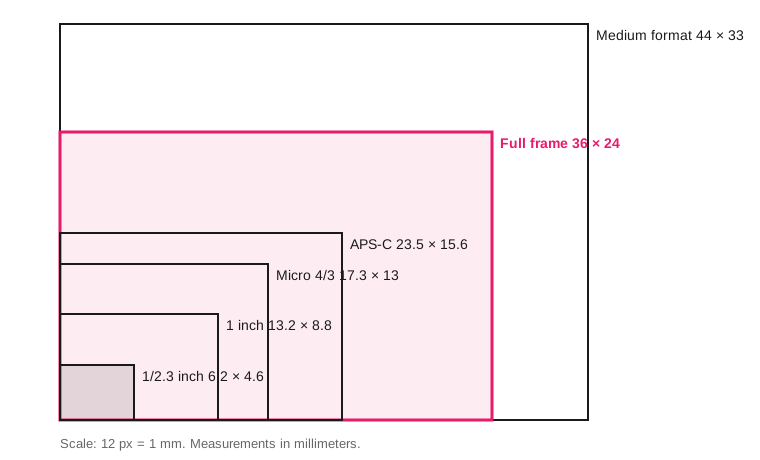
The six formats at true scale, aligned at the bottom-left corner: a Micro 4/3 fits almost four times inside a full frame.
What is the crop factor and where does it come from?
From a division. The diagonal of a full frame is √(36² + 24²) = 43.3 mm. That of an APS-C of 23.5 × 15.6 mm is √(23.5² + 15.6²) = 28.2 mm. Divide: 43.3 ÷ 28.2 = 1.53, which is the famous 1.5×.
With Canon's APS-C measurements, 22.3 × 14.9 mm, the diagonal drops to 26.8 mm and the ratio rises to 1.61: hence that brand's 1.6×. In Micro 4/3 the diagonal is 21.6 mm and the result is exactly 2.0.
What the crop factor does not do is change the focal length of the lens. A 50 mm is still a 50 mm: it projects the same image circle and compresses perspective the same way. What changes is how much of that circle falls within the sensor, and therefore the framing. The long explanation is in crop factor and the quick conversion in the crop factor converter.
Measurements, diagonals and factors, in a table
Format: Medium format; Dimensions (mm): 44 × 33; Diagonal: 55.0 mm; Area: 1,452 mm²; Crop factor: 0.79×; Light vs. full frame: +0.75 stops
Format: Full frame; Dimensions (mm): 36 × 24; Diagonal: 43.3 mm; Area: 864 mm²; Crop factor: 1.0×; Light vs. full frame: reference
Format: APS-C; Dimensions (mm): 23.5 × 15.6; Diagonal: 28.2 mm; Area: 367 mm²; Crop factor: 1.53×; Light vs. full frame: −1.2 stops
Format: APS-C (Canon); Dimensions (mm): 22.3 × 14.9; Diagonal: 26.8 mm; Area: 332 mm²; Crop factor: 1.61×; Light vs. full frame: −1.4 stops
Format: Micro 4/3; Dimensions (mm): 17.3 × 13; Diagonal: 21.6 mm; Area: 225 mm²; Crop factor: 2.0×; Light vs. full frame: −1.9 stops
Format: 1 inch; Dimensions (mm): 13.2 × 8.8; Diagonal: 15.9 mm; Area: 116 mm²; Crop factor: 2.73×; Light vs. full frame: −2.9 stops
Format: 1/2.3 inch; Dimensions (mm): ≈6.2 × 4.6; Diagonal: 7.7 mm; Area: 28 mm²; Crop factor: ≈5.6×; Light vs. full frame: −4.9 stops
The last column is log₂ of the area ratio: a full frame collects 864 ÷ 225 = 3.84 times more light than a Micro 4/3 for the same framing, and 3.84 times is almost exactly two stops.
The inches in the names do not measure anything about the sensor. They come from the convention of television camera tubes in the 1950s, where "1 inch" was the outer diameter of the glass tube and not the useful area. That is why a "1-inch" sensor has a diagonal of 15.9 mm and not 25.4 mm.
Does a bigger sensor give a better photo?
It gives more light collected per frame, and that translates into less noise at equal framing and exposure. The numbers above are the theoretical ceiling: between APS-C and full frame there is a little over one stop, not the three or four that the price difference suggests.
What a big sensor does not give you:
More sharpness. That is resolved by the lens and technique. A 1-inch with good optics at f/4 beats a full frame with a weak zoom at f/22.
More reach. The opposite: for the same distant framing, an APS-C needs less focal length, and that is why a lot of wildlife photography is done on cropped formats.
Better color. It depends on processing and profile, not on area.
How far you can raise the ISO on your particular body is a test you have to do, not a fact you can deduce from the format: the method for measuring it with your own body is in how high to push ISO.
How much does depth of field change with format?
For the same framing and the same distance, a smaller format gives more depth of field, in the same proportion as the crop factor.
Practical translation: f/2 on Micro 4/3 gives the depth of field of f/4 on full frame, with matched framing. On APS-C, f/2 is roughly equivalent to f/3. A half-length portrait with a melted background is easier on full frame; a still life sharp from front to back is easier on Micro 4/3.
Format: Full frame; For the blur of f/2.8 on full frame: f/2.8; For the depth of f/8 on full frame: f/8
Format: APS-C 1.5×; For the blur of f/2.8 on full frame: f/1.8; For the depth of f/8 on full frame: f/5.6
Format: Micro 4/3 2.0×; For the blur of f/2.8 on full frame: f/1.4; For the depth of f/8 on full frame: f/4
Format: 1 inch 2.7×; For the blur of f/2.8 on full frame: f/1.0 (does not exist in practice); For the depth of f/8 on full frame: f/2.8
That is the real reason why a phone's blur is simulated in software: to match an f/2.8 of full frame with a 5.6× sensor you would need an aperture of f/0.5. Check the exact number for your combination in the depth of field calculator.
Which format should I choose based on what I photograph?
What you do: Wildlife, birds, field sports; Format: APS-C; Reason in one line: The 1.5× lengthens every telephoto with no extra weight
What you do: Portrait and wedding; Format: Full frame; Reason in one line: More subject separation and a full stop of margin in low light
What you do: Travel, mountains, video; Format: Micro 4/3; Reason in one line: Body and lenses half the size and weight
What you do: Landscape printed large; Format: Full frame or medium format; Reason in one line: Detail and gradation in skies
What you do: Always carrying a camera; Format: 1 inch; Reason in one line: Fits in a pocket and still separates from the background
What you do: Learning; Format: APS-C; Reason in one line: The budget goes to the lens, which is where you can see it
Frequently asked questions
What does it mean for a sensor to be full frame?
That it measures 36 × 24 mm, exactly the frame size of the 35 mm film roll whose use became widespread in the 1920s. The name is not a quality category, but an inherited measurement, and it serves as the reference for all crop factors.
What is the difference between APS-C and full frame?
The area: 367 mm² versus 864 mm², that is, 2.36 times more area on the full frame, a little over one stop of light. In practice the APS-C frames as if you multiplied the focal length by 1.5 and gives more depth of field at the same aperture.
How many megapixels fit on a small sensor?
As many as you want, but each pixel gets smaller and collects less light. A 24-megapixel full frame has 6-micron pixels; an APS-C with the same 24 megapixels has 3.9-micron ones, and that is why it behaves worse at high ISO with the same technology.
Does the crop factor change the aperture?
It does not change the exposure: f/2.8 lets through the same amount of light per unit of area on any format, so shutter speed and ISO stay untouched. What does change, at equal framing, is depth of field and the total amount of light collected by the frame.
The number worth writing down
Write your camera's crop factor on the case, because you will need it every time you read a focal length recommendation: almost all are written for full frame. With 1.5×, advice to "use 85 mm for portraits" translates to a 56 mm on your mount; with 2.0×, to a 42 mm. The criteria for choosing a focal length are in the guide to lens selection and creative use.
The 44 Enfogram cards come with the focal lengths and apertures per scene printed on them, with the equivalence between formats already worked out.