Lens Selection and Creative Use
Every lens sees the world differently: it changes perspective, compresses planes and alters depth of field. Choosing one is a creative decision.
Two lenses cover 90% of situations: a 24–70mm f/2.8 and an 85mm f/1.8. The rest are specialties. A 24mm covers 84° and "pushes" the viewer into the scene; a 200mm covers 12° and "compresses" reality until it isolates a detail. All the figures on this page assume a full-frame sensor.
Every lens sees the world differently: it changes perspective, compresses planes and alters the depth of field. The choice of lens is a creative decision that affects the visual narrative.
What exactly is focal length?
Focal length is expressed in millimeters (mm). It is not the actual length of the lens, but the distance between the optical center of the lens (the point where the light rays converge) and the plane of the digital sensor or the film.
How much does each focal length cover?
Based on a Full Frame sensor (Fx or FF):
Focal length: 8mm; Angle of view: 180°
Focal length: 18mm; Angle of view: 100°
Focal length: 35mm; Angle of view: 63°
Focal length: 50mm; Angle of view: 47°
Focal length: 70mm; Angle of view: 34°
Focal length: 200mm; Angle of view: 12°
Focal length: 400mm; Angle of view: 6°
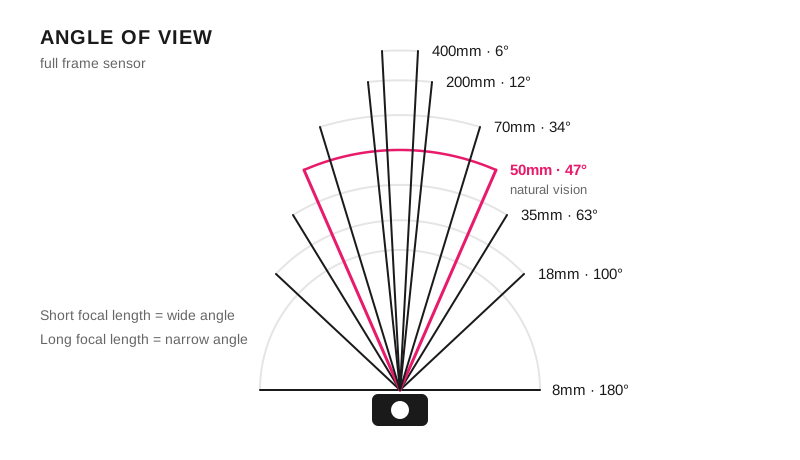
The shorter the focal length, the wider the angle of view: the 50mm comes close to the natural vision of the eye.
When is a lens wide-angle, normal or telephoto?
The shorter the focal length, the wider the angle of view, and objects will appear farther away. The longer the focal length, the narrower the angle of view, and objects will appear closer.
Range: 10mm – 35mm; Classification: Wide-angle
Range: 35mm – 70mm; Classification: Normal
Range: 70mm – 300mm+; Classification: Telephoto
With an APS-C sensor those ranges shift: the crop factor of 1.5× (1.6× on Canon) turns a 35mm into the equivalent of a 52mm and an 85mm into a 127mm. The crop factor converter does the math with your sensor.
Practical application
Wide-angle (14–35mm): expansive landscapes, dramatic architecture, intimate spaces.
Normal (35–70mm): natural vision, versatile portraits, discreet street photography.
Telephoto (70–200mm): portraits with flattering compression, landscape details.
Macro (60mm, 100mm): miniature world, textures, natural abstractions. How to work at those distances is developed in the macro photography guide.
What settings do I use with each lens?
24mm for landscapes: f/8 – f/11, hyperfocal focusing, low ISO.
50mm for street photography: f/2.8 – f/5.6, ISO 400–800, continuous focus.
85mm for portraits: f/1.8 – f/2.8, precise focus on the eyes, background out of focus.
100mm macro photography: f/16 – f/22 to maximize depth of field.
Which lens do I choose for each job?
Job: Open landscape; Focal length (full frame): 24mm; Aperture: f/8 – f/11; Where it puts you: Close to the foreground, with hyperfocal focusing; What it costs: The background recedes and loses size
Job: Architecture; Focal length (full frame): 14 – 24mm; Aperture: f/8 – f/11; Where it puts you: In front of the facade, sensor parallel; What it costs: Distortion and convergence at the edges
Job: Street photography; Focal length (full frame): 50mm; Aperture: f/2.8 – f/5.6; Where it puts you: Two or three steps away, without drawing attention; What it costs: Little margin to crop afterward
Job: Portrait; Focal length (full frame): 85mm; Aperture: f/1.8 – f/2.8; Where it puts you: Two meters or more from the subject; What it costs: A sharp zone of a few centimeters
Job: Landscape detail; Focal length (full frame): 200mm; Aperture: f/8; Where it puts you: Far away, compressing planes; What it costs: Any vibration shows; asks for a tripod
Job: 1:1 macro; Focal length (full frame): 100mm; Aperture: f/16 – f/22; Where it puts you: Centimeters from the subject; What it costs: Diffraction and the need for a lot of light
The focal lengths in the table are for a full-frame sensor. On APS-C, divide by 1.5 to get the same framing: the 85mm portrait is shot with a 56mm and from the same distance.
Common mistakes
Using a wide angle for portraits without considering distortion.
Using a telephoto for broad landscapes (it loses majesty).
Not knowing the lens's minimum focusing distance.
Constantly switching lenses without mastering one first.
Pro tips
Training exercise: practice for a whole week with a single lens to master its "personality."
Basic kit: 24–70mm f/2.8 + 85mm f/1.8, this covers 90% of situations. The comparison between the two most debated portrait focal lengths is in 50mm vs 85mm for portraits.
For travel, prioritize versatility: an all-purpose zoom over extreme quality.
Frequently asked questions
Does a telephoto lens compress perspective?
No: perspective depends only on the distance between camera and subject. What a 200mm does is force you to move back to get the same framing, and that extra distance is what flattens the relationship between near and far. From the same spot, a 200mm and a cropped 24mm give exactly the same perspective.
Which lens do I buy first if I can only buy one?
A 24–70mm f/2.8 or its equivalent in your mount: it covers everything from the landscape wide angle to the short portrait focal length without changing lenses, which is what makes you miss the most photos. Add an 85mm f/1.8 when portraits go from something you do to something you are commissioned for.
Why does my macro at f/22 come out less sharp than I expected?
Because from f/16 on, diffraction starts to subtract resolution across the whole frame, and at f/22 that loss is already visible at 100%. It is still the right compromise when you need millimeters of depth of field in a single shot; if you can take several, shoot at f/8 and stack focus.
Is a wide angle good for portraits?
It works for environmental portraits, with the subject a meter and a half or more away and placed near the center of the frame. What ruins the photo is getting close: closer than a meter with a 24mm, the nose ends up about 10% closer to the sensor than the ears and the face is distorted; and at the edges of the frame faces stretch.
Focal length defines how we see the world.
The 44 cards from Enfogram come with this table of focal lengths and apertures printed on them, so you can choose a lens with the scene in front of you and your bag open.