Film vs Digital Photography
Film or sensor: how exposure, ISO, color and workflow change, and in which situations each one wins. With a comparison table.
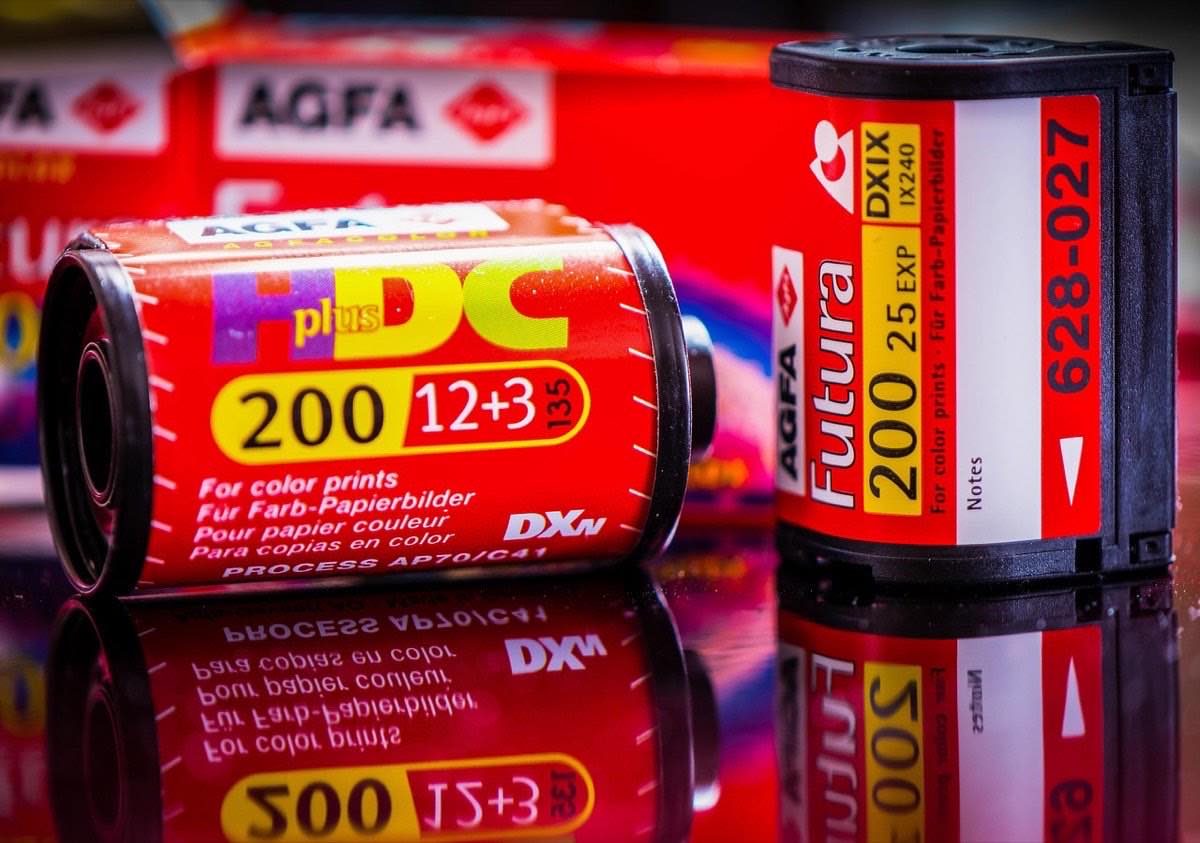
If you're learning, shoot digital: you see the result in a second and can make 500 tests at no cost per shot. Film teaches something else (36 photos per roll force you to decide before pressing) but it teaches slowly, because the mistake and its explanation are separated by days. The technical difference that will affect you most isn't grain or the "look": it's that negative film forgives overexposure and the sensor doesn't.
What really changes between film and sensor?
How they react to light when you overdo it. The sensor responds linearly until the pixel fills up; from there the value is pinned at the maximum and no information is left in the file to recover. The negative compresses the high values more and more as it approaches its limit, so the highlights get squashed but are still there.
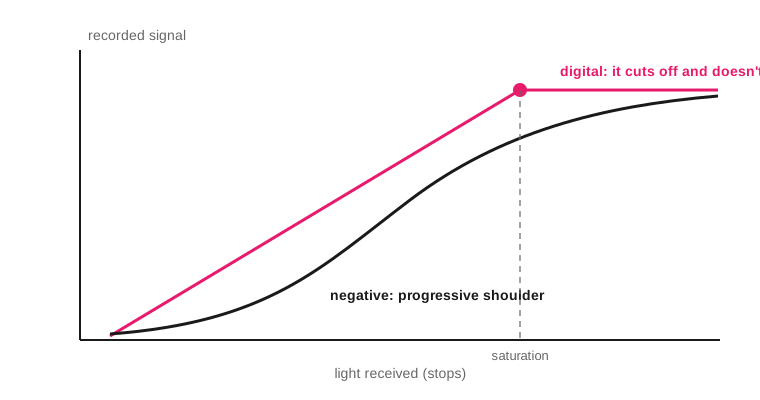
That's why with negative film you overexpose one stop and with digital you protect the highlights.
From this come two opposite rules that are best not mixed up. With color negative film, expose one stop above what the meter says: the shadows gain density and the highlights hold. With digital, expose so as not to clip the highlights and lift the shadows afterward in development, where there's room. With slide film the rule is the digital one and stricter still, because its margin is less than one stop on each side.
Comparison table: film and sensor, point by point
Aspect: Sensitivity; Film: Fixed for the whole roll; Digital: Changes shot by shot; What it means in the field: With film you choose the ISO for the entire day before leaving home
Aspect: Available shots; Film: 36 in 35 mm format; Digital: Thousands per card; What it means in the field: Film forces you to decide; digital lets you experiment
Aspect: Review; Film: None until development; Digital: Immediate; What it means in the field: Correcting a mistake takes a second or a week
Aspect: Exposure latitude; Film: Tolerates overexposure better; Digital: Tolerates underexposure better; What it means in the field: Opposite rules: +1 stop with negative, protect highlights with digital
Aspect: White balance; Film: Fixed in the emulsion: daylight or tungsten; Digital: Adjustable, and in RAW also afterward; What it means in the field: With film you need conversion filters
Aspect: Texture; Film: Silver grain, constant across the whole roll; Digital: Noise that grows with ISO and with heat; What it means in the field: Grain is accepted as an aesthetic; noise almost never
Aspect: Cost per shot; Film: Film, development and scanning; Digital: Zero; What it means in the field: Changes how you shoot more than any setting
Aspect: Workflow until you see the photo; Film: Days; Digital: Minutes; What it means in the field: Learning speeds up with the short cycle
Aspect: Reference format; Film: 36 × 24 mm frame; Digital: Whatever sensor you choose; What it means in the field: "Full frame" is exactly that frame
The dimensions and crop factors of each digital format are in camera sensor sizes.
Which one do I choose if I'm learning?
Digital, without hesitation. Learning photography is about closing a loop: I change a parameter, see what happens, understand the relationship. With film that loop takes a week, and by then you don't remember what aperture you used, unless you write it down shot by shot.
The argument in favor of film ("it forces you to think before you shoot") is true and you can have it in digital too: put in a small card, or shoot in manual without looking at the screen until you get home. Discipline isn't given by the medium, you give it.
What does film do better?
Three concrete things, and none of them is "more quality."
The highlights of a contrasty scene. A white dress in full sun, a window behind a portrait: the negative squashes those values instead of clipping them, and the result has a transition that in digital you have to build in development.
Color without decisions. Each emulsion has its own response and that response is the same across the whole roll. In digital you choose that character yourself in the profile, which gives freedom and also paralysis.
The physical object. A negative can be read against the light thirty years later without any software. A file depends on the format still being openable, which is a real preservation problem and not nostalgia. The formats and their latitude are compared in RAW or JPEG and in the RAW vs JPEG guide.
What does shooting film cost that nobody tells you?
The price of the roll is the small part. Add development, scanning if you want usable files, and time: between shooting and seeing the result, days pass if you send it to a lab. Prices vary a lot between countries and between labs, so check the ones in your city before calculating anything.
There are two costs that are the same everywhere. The first: every shot counts, and that changes how you work in a way that isn't always convenient. Photographing a moving child with 36 exposures and no burst is hard. The second: there's no safety net. A sensitivity error when loading the roll ruins all 36 shots and you find out at development.
Scene: Learning the three controls; What suits: Digital; Reason: The error-correction cycle lasts seconds
Scene: Paid event; What suits: Digital; Reason: No second chances and delivery on a deadline
Scene: Portrait with very contrasty window light; What suits: Color negative; Reason: The curve's shoulder saves the lit side
Scene: Sports, wildlife, kids; What suits: Digital; Reason: Burst, continuous autofocus and variable ISO
Scene: Slow-paced personal project; What suits: Film; Reason: 36 shots force you to edit before shooting
Scene: Night and astro; What suits: Digital; Reason: Film loses sensitivity in long exposures
That last row has a name: reciprocity failure. In exposures of several seconds, film stops responding proportionally to time and you have to lengthen the shot well beyond what the meter says, with a different correction for each emulsion. The sensor doesn't have that problem.
Frequently asked questions
Which is better, film or digital photography?
Digital for learning, for working to deadlines and for anything that moves or has little light. Film when you want the specific response of an emulsion in the highlights or when the 36-shot limit is part of how you work; it's not a question of quality, but of what each one solves for you.
Does film photography have more quality than digital?
In resolution and noise, no: a modern 24-megapixel sensor clearly outperforms a scanned 35 mm negative. What film keeps better is behavior in the highlights, and there it does beat a poorly exposed file.
Can I use my old lenses on a digital camera?
Almost always, with a mount adapter, and more easily on mirrorless bodies because the distance between mount and sensor is shorter. You'll lose autofocus and often aperture control from the body, so you'll work in manual using the aperture ring.
What film ISO should I buy?
ISO 400 color as the single choice if you're only going to carry one type: it holds up from overcast outdoors to indoors by a window, and tolerates a stop of overexposure well. ISO 100 only if you're going to shoot in full sun or on a tripod.
How to try film without ruining the experiment
Start with a roll of ISO 400 color negative in a simple mechanical camera, write down the aperture and shutter speed of each shot on your phone and overexpose one stop relative to what the meter says. When you pick up the development, compare your notes with the results: that notebook is what turns 36 shots into a lesson instead of a surprise. The three controls you'll be noting are the same in both media, and they are developed in the exposure triangle guide.
The 44 Enfogram cards come with the aperture, shutter speed and ISO combinations per scene printed on them, which on a camera without a screen is exactly what's needed.