The History of Photography in 12 Milestones
From the camera obscura to the first digital SLR: twelve dates that explain why your camera works the way it does, and what remains of each.
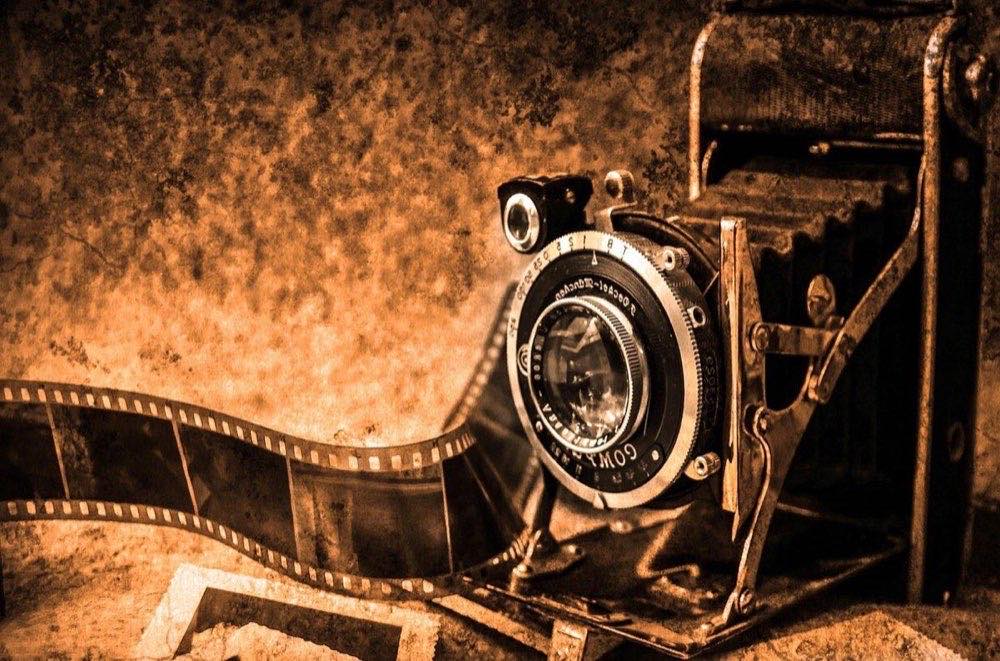
The earliest surviving permanent photograph was made by Joseph Nicéphore Niépce around 1826 from the window of his house at Le Gras, with an exposure of several hours on a pewter plate coated with bitumen of Judea. From that plate to your camera's sensor there are twelve leaps, and almost all of them are still present in the settings you use: the 36 × 24 mm frame, ISO, white balance by color temperature.
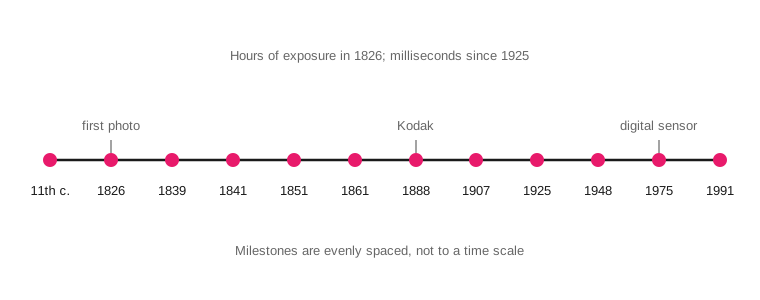
Twelve dates, from the optics described in the 11th century to the first catalog digital SLR.
The 12 milestones, and what changed with each
Year: 11th century; Milestone: Ibn al-Haytham describes the camera obscura; What changed for the person shooting: The optics are understood, but how to fix the image is missing; Typical exposure: —
Year: Around 1826; Milestone: Niépce's heliograph; What changed for the person shooting: The first permanent image exists; Typical exposure: Several hours
Year: 1839; Milestone: Daguerreotype, presented in France; What changed for the person shooting: Portraiture appears: a single copy, no negative; Typical exposure: Minutes
Year: 1841; Milestone: Talbot's calotype; What changed for the person shooting: The negative is born: one shot, many prints; Typical exposure: A minute or less
Year: 1851; Milestone: Wet collodion; What changed for the person shooting: More sensitive and cheaper, but you have to develop on the spot; Typical exposure: Seconds
Year: 1861; Milestone: Maxwell projects in three colors; What changed for the person shooting: It is shown that color is composed of three records; Typical exposure: —
Year: 1888; Milestone: Kodak No. 1; What changed for the person shooting: The photographer stops developing: you send in the whole camera; Typical exposure: Snapshot
Year: 1907; Milestone: The Lumières' Autochrome; What changed for the person shooting: First color process within reach of the public; Typical exposure: Seconds
Year: 1925; Milestone: Leica I; What changed for the person shooting: The 35 mm format, 36 × 24 mm, becomes the standard; Typical exposure: Milliseconds
Year: 1948; Milestone: Polaroid Land 95; What changed for the person shooting: The print comes out of the camera in minutes; Typical exposure: Snapshot
Year: 1975; Milestone: Kodak digital prototype; What changed for the person shooting: The image stops being chemical and becomes a file; Typical exposure: 23 s to record
Year: 1991; Milestone: First catalog digital SLR; What changed for the person shooting: The professional workflow begins to abandon the film roll; Typical exposure: Milliseconds
What was the first photograph in history?
Point de vue du Gras, the view from the window of Niépce's workshop, usually dated around 1826 or 1827. The plate was pewter covered with bitumen of Judea, a material that hardens where light strikes it; washing away what hadn't hardened afterward left the image.
The exact length of that exposure is still debated: the traditional figure is about eight hours, and some later reconstructions maintain it was several days. What is certain, and explains the image, is that it lasted so long that the shadows of the buildings changed sides during the shot, which is why the two opposite walls appear lit at the same time.
Niépce died in 1833. His partner, Louis Daguerre, kept working and in 1839 presented the daguerreotype, the process by which photography became a business.
When did color arrive?
Earlier than almost everyone assumes. James Clerk Maxwell demonstrated the principle in 1861 by projecting three transparencies of the same Scottish ribbon, taken with red, green and blue filters, superimposed. That three-record principle is exactly what your sensor's color filter array does.
Commercial color arrived with the Autochrome plate from the Lumière brothers, on the market since 1907: potato starch grains dyed red, green and blue acting as tiny filters. The modern version, three-layer color film, became popular starting in the 1930s.
That system had a consequence that is now solved with a menu: the film came balanced for a fixed color temperature, daylight or tungsten, and any other light required putting a filter in front of the lens. Adjustable white balance is a very recent convenience.
When did film stop being used?
In professional work, between 1999 and 2005. The first catalog digital SLR arrived in 1991, mounting a digital back on a film body, and over the following decade prices fell while resolution rose; the point of no return was the daily press, which needed to send images the same day.
Film didn't disappear: it came back as an aesthetic choice and as a working discipline, with 36 shots per roll and no rear screen. What each does better is in analog vs digital photography.
What of all this is still inside your camera?
More than it seems, and knowing it explains several settings that otherwise seem arbitrary.
The 36 × 24 mm frame that we now call full frame is the measurement set by the 1925 format, and every crop factor comes from it. The dimensions of all formats are in camera sensor sizes.
The ISO scale inherits the sensitivity scales of film: doubling the number is doubling the sensitivity, just as you went from a 100 roll to a 200 roll.
The aperture series f/1.4 · f/2 · f/2.8 · f/4 advances by multiplying by √2 because each step halves the effective area of the aperture, a convention that predates any electronics.
The two-curtain shutter is mechanics from almost a century ago that is still mounted in current bodies; its flash sync limit comes from there. The detail is in mechanical and electronic shutter.
White balance by color temperature in kelvin translates into a menu what used to be conversion filters screwed onto the lens.
Frequently asked questions
Who invented photography?
There was no single inventor. Niépce achieved the first surviving permanent image around 1826, Daguerre made the process commercially viable in 1839 and Talbot contributed the negative in 1841, which is what made it possible to make prints. All three are necessary for photography to exist as we use it.
When was the first photograph of a person taken?
In a daguerreotype of the Boulevard du Temple in Paris, made by Daguerre around 1838. The exposure lasted several minutes, so the traffic and pedestrians disappeared completely and all that was recorded was a man who had stopped to have his shoes shined.
Why don't people smile in old photos?
Mostly because of the exposure time: holding a still smile for minutes is impossible, and a moving mouth ruins the portrait. When exposures dropped to fractions of a second, the social convention of the serious portrait still took a few decades to change.
What was the first digital camera?
A prototype built in 1975 in Kodak's laboratories by engineer Steven Sasson, which recorded a low-resolution black-and-white image onto a cassette tape and took 23 seconds to do so. It was never marketed: the first catalog digital SLR took another sixteen years to arrive.
What this history saves you in the field
Every convention that seems capricious has a date behind it, and knowing which makes it easier to remember: aperture steps go by √2, ISOs double, and "full frame" is a 1925 measurement and not a quality category. How those three controls relate to each other is in the exposure triangle guide, and where the craft is heading now, in the guide to contemporary trends and digital future.
The 44 cards from Enfogram have those scales and the settings by scene printed on them, on paper, which is still the medium that never runs out of battery.