Event and Social Occasion Photography
Event photography is real-time journalism: anticipate moments, work in changing conditions and capture authentic emotion without being seen.
Two bodies, 24–70mm and 70–200mm, auto ISO capped at 3200 and continuous focus. With that you cover an entire ceremony without changing lenses or losing a moment by twisting lens rings. Everything else (anticipating, positioning, disappearing) is reading the room.
Event photography is real-time journalism: you anticipate moments, work in lighting conditions that change every fifteen minutes and have to be almost invisible while capturing reactions that happen only once. Reaction speed weighs as much as technical mastery.
A story told with living images.
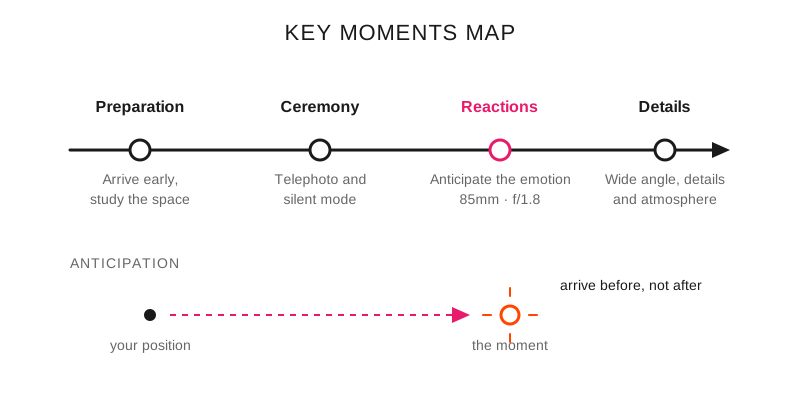
Know the event's protocol and position yourself before each moment: the emotion doesn't repeat.
What do I do at each moment of the event?
Formal ceremonies: telephoto, discreet positions, key moments anticipated.
Social receptions: wide angle, close interaction, mixed ambient light.
Intimate moments: 85mm, wide apertures (f/1.4 – f/2), focus on genuine expressions.
Family and friend groups: quick setup, minimal direction, multiple options.
What do I bring and how do I set it up?
Dual bodies: 24–70mm + 70–200mm for full coverage without changes.
Auto ISO: limit 3200, prioritize speed over perfect quality.
Continuous focus: tracking of moving subjects, with face and eye detection if your camera has it. The modes and when to switch between them are in the focus systems guide.
Bounced flash: when necessary, always diffused and directional.
What settings do I use at each moment of the event?
Moment: Outdoor cocktail hour, open shade; Focal length (full frame): 24–70mm; Aperture: f/4; Shutter speed: 1/500 s; ISO: 200; What it costs: Nothing; it is the easiest light of the day
Moment: Formal ceremony; Focal length (full frame): 70–200mm; Aperture: f/2.8; Shutter speed: 1/250 s; ISO: 1600–3200; What it costs: Short sharp zone: focus on the eyes
Moment: Speeches and toasts; Focal length (full frame): 70–200mm; Aperture: f/2.8; Shutter speed: 1/250 s; ISO: 3200; What it costs: The ISO cap is reached right away
Moment: Intimate moments; Focal length (full frame): 85mm; Aperture: f/1.4 – f/2; Shutter speed: 1/160 s; ISO: 1600; What it costs: A few centimeters of focus; one turned head and it fails
Moment: Dancing and reception; Focal length (full frame): 24–70mm; Aperture: f/2.8; Shutter speed: 1/200 s; ISO: 3200; What it costs: Hands and feet still blurred; use bounced flash
Moment: Family groups; Focal length (full frame): 35mm; Aperture: f/5.6; Shutter speed: 1/125 s; ISO: 3200; What it costs: You need bounced flash to reach the back row
Shutter speeds come from two things and not one: the reciprocal rule (1/200 s at minimum with the 200mm so it doesn't shake) and what moves in front of you. 1/250 s freezes someone gesturing while speaking; 1/160 s holds a still person but leaves the hand raising a glass blurred; below 1/125 s on a dance floor half the shots are lost. If you have to choose, raise the ISO before lowering the shutter speed: noise can be corrected and motion can't. How that tradeoff is distributed is in the low-light photography guide, and you can try the combinations in the exposure triangle simulator.
Common mistakes
Being too intrusive during emotional moments.
Slow setup that loses decisive moments.
Direct flash that ruins the natural atmosphere; how to bounce it well is in the flash lighting guide.
Not anticipating the key moments of the event's protocol.
Pro tips
Strategy: arrive early to learn the space and plan positions.
Use silent shooting mode during ceremonies so you don't interfere.
Carry two setups: one with a wide angle and one with a telephoto to always be ready.
Frequently asked questions
What minimum shutter speed do I use at a reception?
1/200 s with people who move little and 1/250 s as soon as the dancing starts or someone gestures while speaking. Below 1/125 s handheld, between the subject's movement and yours, a good part of the shots comes out blurred and no setting fixes it. If the light isn't enough, raise the ISO: noise is corrected in development and motion isn't.
How high can I take the ISO at an event?
Set the auto ISO cap at 3200 and decide with the photo in front of you whether your camera can take more. The real limit depends on the model and the size at which the image will be viewed: a photo published at 1,000 pixels wide tolerates much more noise than the same photo printed at 30 cm. Losing the moment to keep the ISO low is a mistake that can't be recovered.
Flash or no flash during the ceremony?
Not during moments of silence or closed protocol, and in many places of worship it is outright prohibited: ask before starting. At the reception, yes, always bounced off a light ceiling or wall, never direct at the subject, because direct flash flattens the face and erases the ambient light that gives the scene its atmosphere.
Can a single body cover an entire event?
It can, but you pay the price in lost moments and dust inside the sensor from lens changes. If you only have one body, mount the 24–70mm and stay with it: you lose tight shots from far away, but you lose nothing by changing optics when the important thing happens. The second body is the first purchase that pays for itself in this work.
The story happens only once; your job is not to interrupt it.
The 44 cards from Enfogram have these settings printed by moment, so you can resolve them in your jacket pocket and not in the camera menu.