Smash Cake and Newborn Photography, Step by Step
How to set up a baby session safely: non-negotiable handling rules, window light and measured settings for full frame.
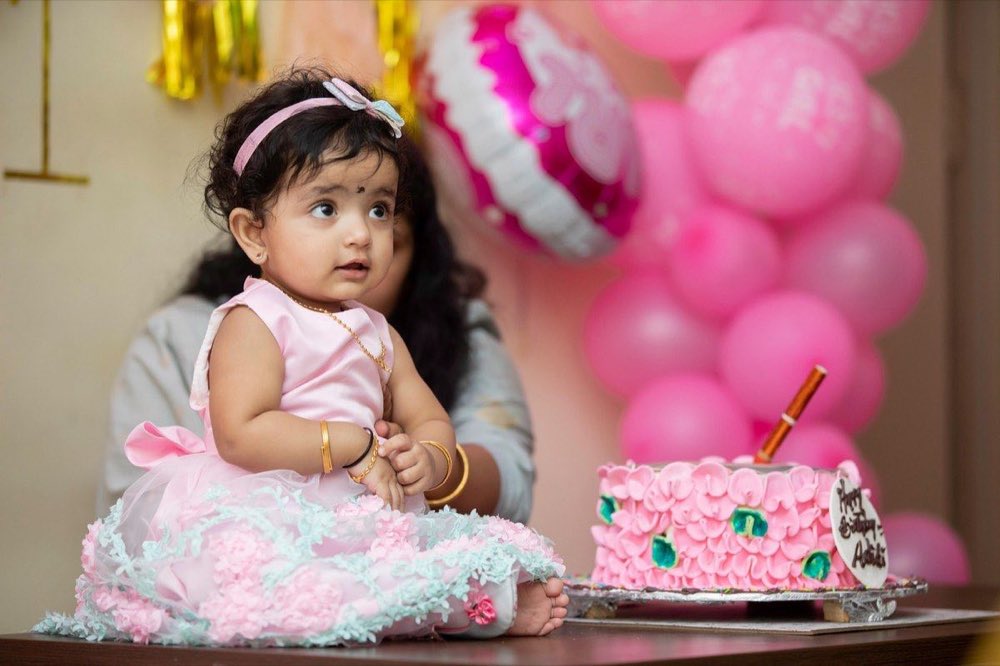
With window light on full frame, 50 mm at f/4 and 1/125 s with ISO 800 handle a sleeping baby; the cake at 1/250 s, f/4 and ISO 1600 because at that age the hands are already flying. Those are the two settings that support everything else. And one rule that comes before any setting: never place a baby in a posture or a prop they can't get out of on their own if you let go.
The two sessions are the same client eleven months apart with opposite problems: one is a motionless subject with strict safety requirements and the other is a subject who moves the whole time and gets everything dirty.
What safety rules are non-negotiable with a newborn?
These six, and none admits an exception because the photo would look better.
Someone within arm's reach, always. A father, a mother or an assistant with hands near the baby on every shot. You are looking through the viewfinder and can't see what is about to happen.
The froggy pose is never done in a single shot. That image where the baby rests their chin on their hands is composited in editing from two photographs in which an adult holds the head and wrists. Without an assistant and without compositing, it is not attempted.
No prop where the baby isn't supported. Baskets, crates, buckets and hammocks are padded and stabilized, and a hand stays on out of frame even if it looks firm.
No joint is forced. If a leg or an arm offers resistance, it is left where it is. The baby decides the range, not the pose catalog.
A warm room and your hands clean and warm. A naked newborn loses heat fast; if you are comfortable in short sleeves, it is cold for them. Short nails, no rings or bracelets.
If you are sick, it is canceled. No photo makes up for that conversation.
Ask the parents before starting whether there is any medical or birth condition that limits handling: that answer overrides your shot list. And keep in mind that curled-up poses work in the first ten or fifteen days, while the baby still folds up; after that the session changes genre and becomes an awake portrait.
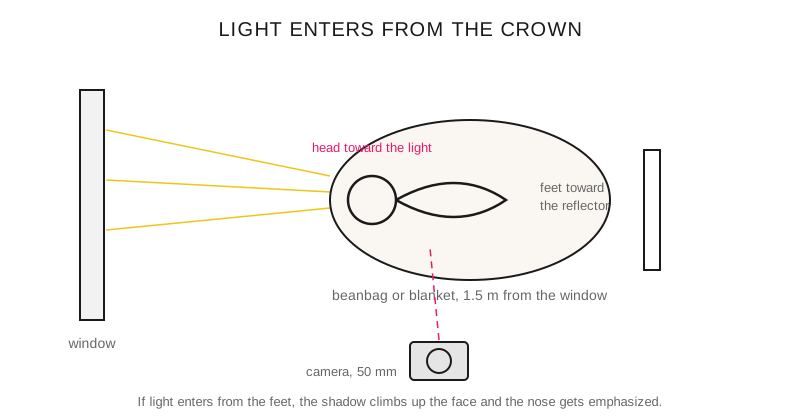
Head toward the window, feet toward the reflector and camera from the feet side. Reversing that axis is the most common lighting mistake in the genre.
What settings do I use with a baby and window light?
Starting values on full frame, with the window at 1.5 m and an overcast day.
Scene: Sleeping newborn, wide shot; Focal length: 50 mm; Aperture: f/4; Shutter speed: 1/125 s; ISO: 800; What it costs: 1/125 s doesn't forgive a startle
Scene: Detail of hands, feet or eyelashes; Focal length: 100 mm macro; Aperture: f/5.6; Shutter speed: 1/125 s; ISO: 1600; What it costs: Visible noise; at f/5.6 macro the sharpness is millimeters
Scene: Parents holding the baby; Focal length: 50 mm; Aperture: f/2.8; Shutter speed: 1/250 s; ISO: 800; What it costs: With two faces at different distances, one comes out soft
Scene: One-year-old, smash cake; Focal length: 35 mm; Aperture: f/4; Shutter speed: 1/250 s; ISO: 1600; What it costs: Evident grain in the whites of the cake
Scene: Smash cake with flash bounced off the ceiling; Focal length: 35 mm; Aperture: f/8; Shutter speed: 1/200 s; ISO: 200; What it costs: The bounce eats power; slow recycling
The first four rows are the same amount of light distributed in different ways, so you can move between them by compensating one parameter with another. The fifth changes the rule: with flash, the subject's exposure is set by power and distance, not ISO.
Three more decisions that matter as much as the table:
f/4 as the minimum aperture on a newborn. At f/1.8 with a 50 mm at 1 m you have about 4 cm of sharpness: one eye fits and the hand resting on the cheek doesn't. Check your combination in the depth of field calculator.
1/250 s as the floor on smash cake. Below that, the hands come out blurred every other shot and the moment doesn't repeat.
Fixed white balance in tungsten or daylight, depending on the source. Mixing the ceiling lamp with the window produces green faces that cost half an hour of editing per session.
The newborn poses you can do without an assistant
Four, and all four are variations on "the baby is supported and can't roll."
On the back, arms next to the face. The default posture and the safest. Camera from the feet side, a bit above.
On the side, knees tucked. With a rolled towel under the blanket so they don't roll, never with the blanket alone.
Face down on a parent's forearms. The adult is the support and also enters the frame.
In arms, looking over the shoulder. It solves the family photo and the baby's portrait in one go.
The ones that need an assistant and compositing: the froggy pose, any support on an elevated basket and anything that means the head doesn't rest on a surface. If you work alone, skip them. For the middle stretch between the newborn session and the first-year one, the settings and play strategies are in photographing kids.
How to set up a smash cake session
It is done around eleven or twelve months, when the baby can already sit alone and doesn't yet walk enough to escape the backdrop. It is usually photographed before the birthday so the images are ready in time.
An order that works and lasts about forty minutes:
Ten minutes dressed, without cake. Clean portraits and a family photo. If the session goes sideways later, you already have a deliverable.
Present the cake from a distance. Many babies don't touch it during the first minute. Let them look at it, point at it, and then you bring it closer.
Let them destroy it without directing. The best shots come from the initial disgust and the laughter afterward, not from the act of eating.
A parent out of frame, at one meter. So the baby doesn't stand up and so you can step in if they choke.
Close with water. A clear tub with two fingers of warm water gives a second full series and solves the cleanup.
Set preparation: plain light backdrop, floor covered with plastic and a cloth on top (bare plastic shines and shows), and the cake at the height of the seated baby. Ask the parents about allergies and ingredients before ordering the cake, and have them bring it if there is any doubt.
A white cake in front of a large window fools the meter and the camera underexposes: compensate +0.7 EV or meter on the face. If you use flash, bounce it off the ceiling so the light falls from above and doesn't create glare on the frosting; the criteria for dosing it are in fill light and the full setup in the flash lighting guide.
Frequently asked questions
At what age is the newborn session done?
Between five and fifteen days of life is the window in which the baby keeps the curled-up posture and sleeps deeply between shots. After that it is still possible to photograph them, but closed poses stop coming out and the session becomes an awake portrait, with more participation from the parents.
Is it safe to put the baby in baskets and props?
Only if they are supported and with an adult within arm's reach at all times. Props are stabilized beforehand with weight, padded so the baby doesn't sink in, and there is always a hand out of frame; images that look impossible are composited from two shots in editing.
What do I need for a smash cake session?
A plain backdrop, plastic covered with cloth for the floor, a cake appropriate for the age and agreed with the parents, towels and a tub with warm water for the closing. On camera, 35 mm on full frame, f/4, 1/250 s and ISO on auto with a cap of 3200.
How long does a baby session last?
The newborn one, between two and three hours, because the time is set by feedings and diaper changes, not you. The smash cake one, forty minutes at most: after that the baby is tired, sticky and has already given everything they had.
The bag you carry and the order of the day
For newborn: plain blankets, two rolled towels to wedge postures, hand sanitizer and a heat source if the room is cold. For smash cake: plastic, cloth, towels, a tub, a change of clothes and the cake agreed with the parents.
And a decision that saves entire sessions: do the clean portraits in the first ten minutes. If the baby decides today is not the day, the parents still leave with photos. The window setup that supports both sessions is detailed in window light portrait: a simple setup.
The 44 cards from Enfogram have the window light and bounced flash settings printed on them, so you can consult them with the baby in your arms and without letting go.