What Is Photography and What Types Exist
Definition of photography, how the image forms inside the camera, the four controls that decide it and the types with their focal lengths and apertures.
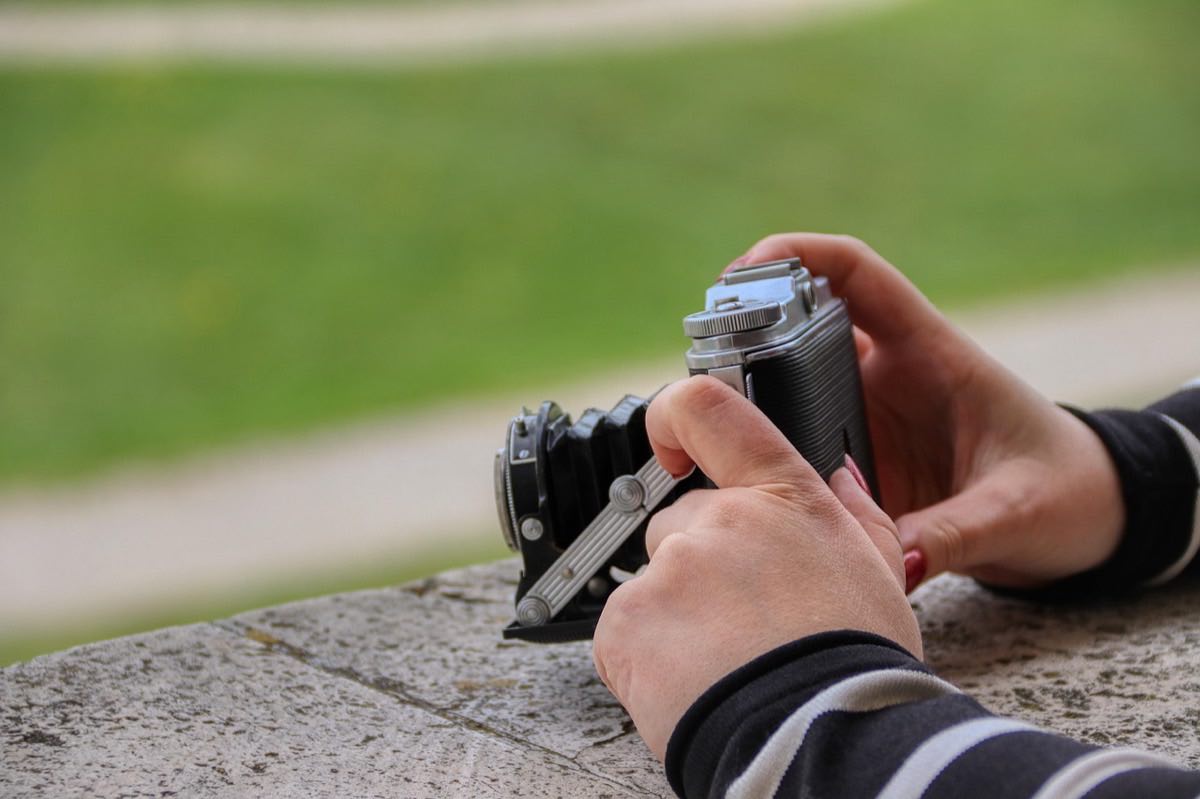
Photography literally means "writing with light," from the Greek phos (light) and graphé (writing). Technically it is recording on a sensitive surface the light that a lens concentrates over a measured time, ranging from 1/8000 s to several hours. Everything else (genres, styles, gear) is a way of deciding how much light, for how long and from where.
How does the image form inside the camera?
A lens gathers the rays coming from each point of the scene and brings them back together at a point on the sensor plane. Because the rays cross as they pass through the lens, the image arrives inverted: top to bottom and left to right. The screen and viewfinder show it to you right side up, but the sensor receives it upside down.
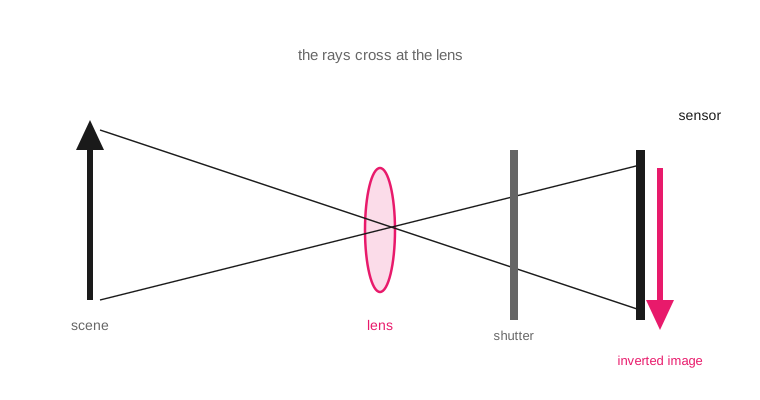
The same geometry as the camera obscura: rays that cross and an inverted image at the back.
That principle is older than photography: the camera obscura was described centuries before a surface existed that could hold the image. What was invented in the 19th century was not the image, but the way to fix it. How it happened is in history of photography in 12 milestones.
What controls decide a photograph?
Four, and all four can be adjusted on any camera with manual mode.
Aperture regulates how much light enters at once and how much depth of field there is: f/1.8 melts the background away, f/11 keeps almost everything sharp. Shutter speed sets how long the shot lasts: 1/1000 s freezes a cyclist, 1/15 s turns them into a streak. ISO amplifies the sensor's signal: go up two stops and you gain two stops of light, in exchange for noise. The three compensate for each other, and that relationship is explained in the exposure triangle guide.
The fourth is not about exposure: the focus point. It decides which plane of the scene is sharp, and it is the only one of the four that can't be corrected afterward.
A fifth decision precedes them all: the focal length, because it defines the framing and the perspective from where you stand. The criteria are in the guide to lens selection and creative use.
How many types of photography are there?
There is no closed list, because genres are defined by what is photographed and for what purpose. These nine cover almost everything people practice, and each has a different technical starting point.
Type: Portrait; Focal length (full frame): 85 mm; Starting aperture: f/2; Minimum shutter speed: 1/125 s; What it demands: Focus on the nearest eye
Type: Landscape; Focal length (full frame): 24 mm; Starting aperture: f/8; Minimum shutter speed: Tripod or 1/30 s; What it demands: Hyperfocal focusing
Type: Street; Focal length (full frame): 35 mm; Starting aperture: f/5.6; Minimum shutter speed: 1/250 s; What it demands: Anticipating the scene
Type: Sports; Focal length (full frame): 200–400 mm; Starting aperture: f/2.8; Minimum shutter speed: 1/1000 s; What it demands: Continuous tracking
Type: Wildlife; Focal length (full frame): 400 mm; Starting aperture: f/5.6; Minimum shutter speed: 1/1000 s; What it demands: Distance and patience
Type: Macro; Focal length (full frame): 100 mm; Starting aperture: f/8; Minimum shutter speed: 1/200 s; What it demands: Exact focus distance
Type: Night and astro; Focal length (full frame): 20 mm; Starting aperture: f/2; Minimum shutter speed: 10–20 s; What it demands: Tripod and manual focus
Type: Product; Focal length (full frame): 50–100 mm; Starting aperture: f/8; Minimum shutter speed: Flash sync; What it demands: Controlled light
Type: Architecture; Focal length (full frame): 17–24 mm; Starting aperture: f/8; Minimum shutter speed: Tripod; What it demands: Straight verticals
The numbers are starting points on full frame, not complete exposures: the ISO is set by the light in front of you. If you shoot on APS-C or Micro Four Thirds, divide the focal length by your crop factor in the crop factor converter.
What separates a good photo from a correct one?
The correct one is well exposed and sharp. The good one, in addition, decides three things before shooting: where the photographer stands, what they leave out of the frame and at what moment they press.
Of the three, position is the one that changes the result the most and the one used the least. Lowering the camera 40 cm in a portrait of a child, or stepping back two meters and raising the focal length, transforms the image more than any adjustment. Framing is above all excluding: almost every weak photo has too many things in it.
Where do I start?
With a single genre and a single focal length for a month. A 35 mm on the street or a 50 mm in portraiture teaches more in four weeks than six lenses alternated over a year, because you end up seeing the framing before raising the camera.
Shoot in aperture priority mode while you learn to read depth of field, and switch to manual as soon as the light stops changing between shots: an interior with a window, a studio, night on a tripod. Save the files as RAW from day one; the difference from JPEG is in RAW or JPEG.
Frequently asked questions
What is photography in a few words?
It is the permanent record of an image formed by the light that passes through a lens during a controlled time. The word comes from the Greek phos (light) and graphé (writing), and it describes exactly what happens: light leaves a mark on a sensitive surface.
What are the most practiced types of photography?
Portrait, landscape, street, product and documentary account for most of what gets photographed, both as a hobby and professionally. Each is distinguished by its usual focal length and its main technical demand: focus in portraiture, depth of field in landscape, anticipation in street.
Do I need a camera to learn photography?
You can start with a phone if it has a manual mode or an app that provides one, because composition and reading light are learned the same way. The limits arrive in low light, with a real telephoto lens and with background blur, which is where sensor size decides.
What is correct exposure?
The one that records the information you care about without clipping the highlights you want to keep. There is no ideal histogram: a correctly exposed night scene is loaded to the left, and forcing it to the center only adds noise.
The first thing to practice this week
Choose a fixed focal length, go out with the camera in aperture priority and take twenty photos of the same subject from twenty different positions: crouching, from above, at one meter, at ten. Compare at home which one works and why. It is the exercise that most quickly separates the technical adjustment from the visual decision, and it costs nothing. If you want to pick a genre first, the comparison of camera types is in types of cameras.
The 44 Enfogram cards collect the starting settings for each of these genres on paper, so you can consult them without a screen while you shoot.