Skip to content
← Glossary

Light painting

Light painting is a technique where you move a light source in front of the camera during a long exposure, leaving a drawing made of light.

Also known as: light drawing, light writing
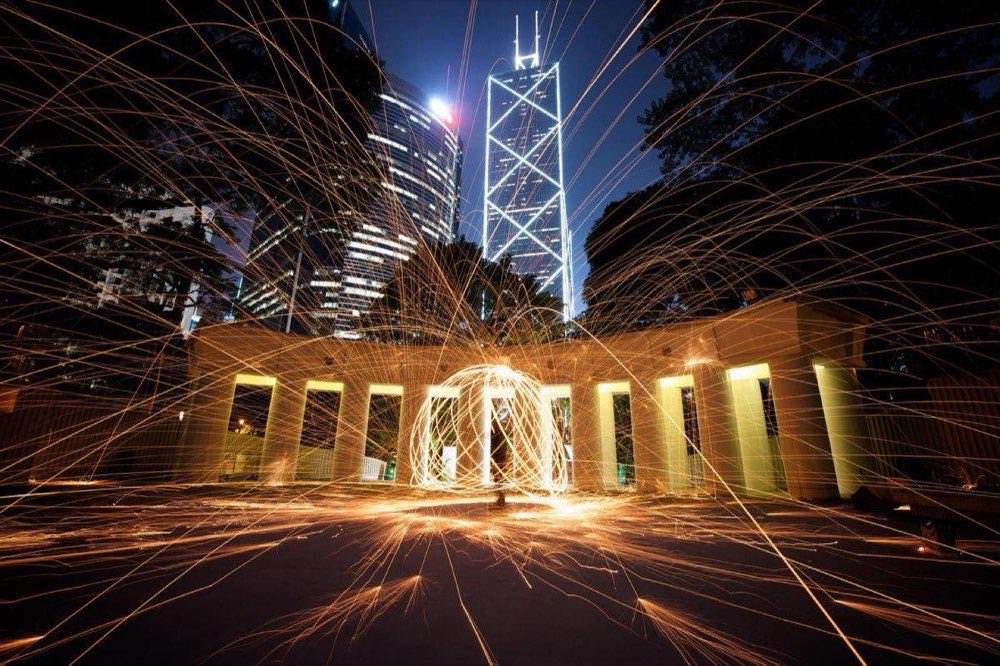
Steel wool sparks spinning in front of a pavilion with lit skyscrapers behind it, recorded in a long night exposure

Light painting is a technique that involves moving a light source (a flashlight, a phone, colored LED lights) in front of the camera during a long exposure in a dark environment, leaving the trail of that movement recorded as a drawing or pattern of light in the final image.

It requires a tripod (the camera must stay completely still), a dark environment so that only the moving light is recorded, and exposures that typically run from several seconds to several minutes, depending on the complexity of the trail you want.

For the step-by-step process, including camera settings and light-writing techniques, see light painting: painting with light step by step and the guide to experimental techniques and creative photography.

  • Blog
    Night Portraits with Flash and Ambient Light

    Night portrait with flash: balance ambient light and flash with exact settings, rear-curtain sync, gels and a well-used guide number.

  • Glossary
    Catchlight

    A catchlight is the specular reflection of the light source in a subject's eyes in a portrait, giving the gaze life and depth.

  • Guide
    Studio Lighting Concepts

    Studio lighting is architecture with light: each source has a function and its quality depends on the relative size of the source.

  • Blog
    Boudoir Photography: Light, Poses and Confidence

    How to approach boudoir professionally: the pre-shoot conversation, written consent, window light and measured settings for full frame.

  • Glossary
    Blue hour

    Blue hour is the brief window of light just before sunrise or after sunset, when the sun is below the horizon but its light still tints the sky deep blue.

  • Guide
    Low-Light Photography

    Having little light is not a problem, it's a creative opportunity. The key is balancing ISO, aperture and shutter speed to match your creative vision.

  • Guide
    Studio Lighting Concepts

    Studio lighting is architecture with light: each source has a function and its quality depends on the relative size of the source.

  • Guide
    Low-Light Photography

    Having little light is not a problem, it's a creative opportunity. The key is balancing ISO, aperture and shutter speed to match your creative vision.

  • Guide
    Natural Light Basics for Photographers

    Natural light constantly changes in quality, direction and intensity. There is no "bad light," only light unsuited to what you are trying to communicate.

  • Guide
    Flash Lighting Without Auto Mode

    Flash doesn't just add light: it sculpts the exact mood you need by understanding the relationship between power, aperture, ISO and ambient light.

  • Guide
    Creative White Balance

    White balance is a storytelling tool: adjusting it manually lets you create atmospheres that support your visual message.

  • Guide
    Strategic Light Metering

    Metering systems do not know what is important in your scene: understanding each mode gives you creative control over exposure.